Photos & Videos
101 media items in Truth and Reconciliation Commission - Peru
Tag
mrta
×
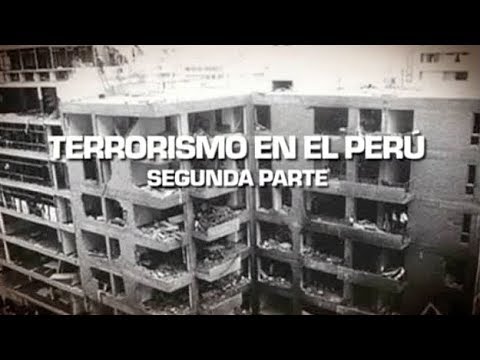
Terrorism in Peru - Part II
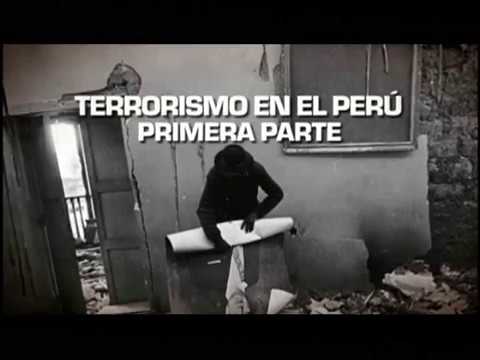
Terrorism in Peru - Part I
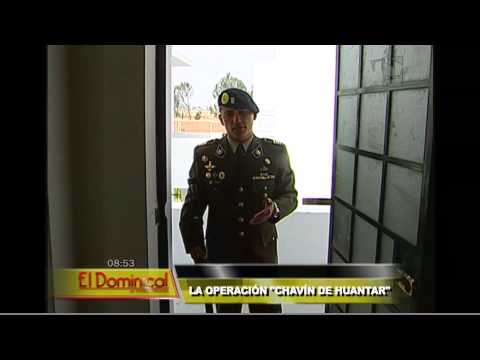
Chavín de Huantar: the heroes who gave their lives 17 years ago speak. Report
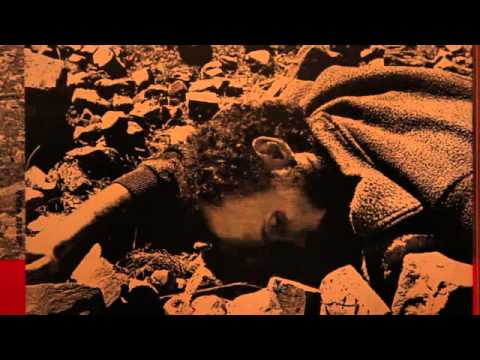
Why did terrorism begin in Peru?
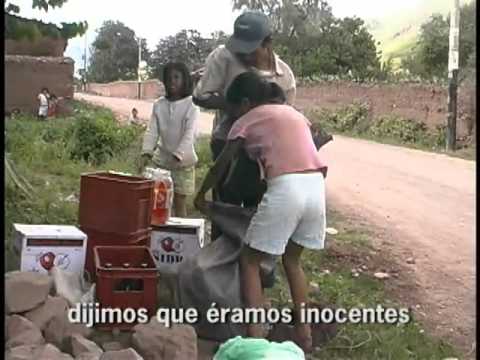
"Spreading the truth". Documentary.

A day in memory - Blog
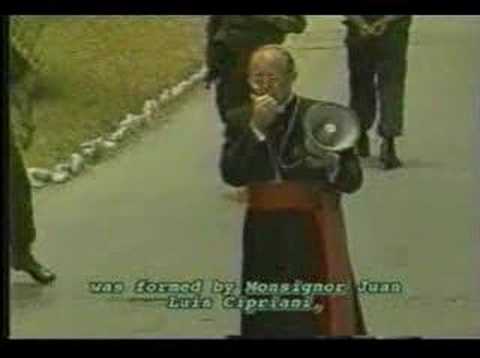
Chavín de Huántar: the history

"Three years that changed history". Pro-Fujimori documentary. Part 2
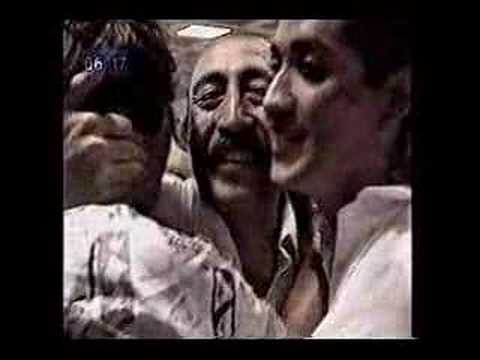
"Chavín de Huántar: at the end of the tunnel". TV film. Part 9
"Chavín de Huántar: at the end of the tunnel". TV film. Part 8
"Chavín de Huántar: at the end of the tunnel". TV film. Part 7
"Chavín de Huántar: at the end of the tunnel". TV film. Part 6
"Chavín de Huántar: at the end of the tunnel". TV film. Part 5
"Chavín de Huántar: at the end of the tunnel". TV film. Part 4
"Chavín de Huántar: at the end of the tunnel". TV film. Part 3
"Chavín de Huántar: at the end of the tunnel". TV film. Part 2
"Chavín de Huántar: at the end of the tunnel". TV film. Part 1

MRTA
Messages from the CVR Final Report: Truth as a process
Messages from the CVR Final Report: National reconciliation

Messages from the CVR Final Report: Comprehensive reparations plan
Messages from the CVR Final Report: Self-defense committees
Messages from the CVR Final Report: Shining Path.
Messages from the CVR Final Report: (IN) Justice
Messages from the CVR Final Report: Victims
Messages from the CVR Final Report: The data
Women and violence

"State of Fear". Documentary. Trailer
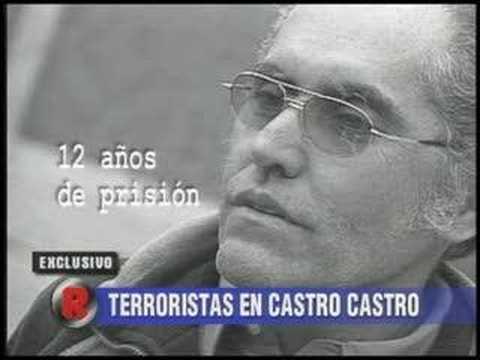
Terrorists at Castro Castro

Testimony before CVR: murder of the residents of the Community of Callqui Nisperocniyocc

CVR public hearings: thematic hearing on violence against the educational community. November 2002

CVR public hearings: thematic hearing on displaced communities. November 2002

CVR public hearings: Trujillo. September 2002

CVR public hearings: Lima. Thematic hearing, violence against women. September 2002

CVR public hearings: Abancay. August 2002

CVR public hearings: Tingo María. August 2002

CVR public hearings: Lima. July 2002

CVR public hearings: Lima. June 2002

CVR public hearings: Huancayo and Huancavelica, May 2002

CVR public hearings: Huanta. April 2002
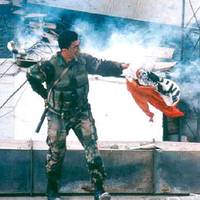 1997
1997
Special Forces commando burns an MRTA flag during Operation Chavín de Huantar
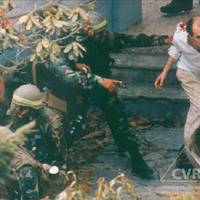 1997
1997
Special Forces commandos rescue the Foreign Minister from the Japanese ambassador's residence
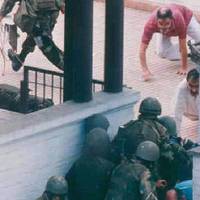 1997
1997
Special Forces commandos rescue two of the hostages from the Japanese ambassador's residence
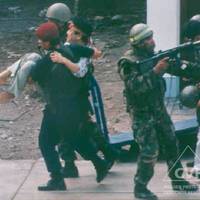 1997
1997
Special Forces commandos rescue one of the hostages from the Japanese ambassador's residence
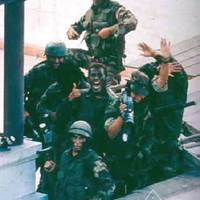 1997
1997
Special Forces commandos celebrate the rescue of hostages from the Japanese ambassador's residence
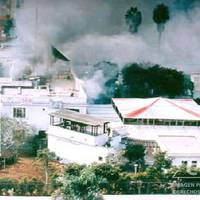 1997
1997
Panoramic view of the Japanese ambassador's residence
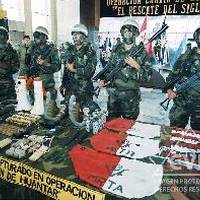 1997
1997
Exhibition of seized MRTA materials
 1997
1997
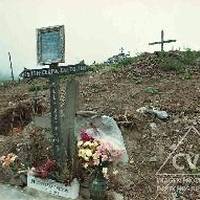
Tomb of Néstor Cerpa Cartolini
 1996
1996
American citizen Lori Berenson is presented to the press after being captured
Showing 1–50 of 101 items
Timeline Events 50
-
Resolution of merit to proceed to oral trial
On October 2, 2002, the National Court of Terrorism, Criminal Organizations and Gangs, by Resolution declared that there was merit to proceed to oral trial against those accused of the kidnapping of Raul Hiraoka Torres. The process continued with hearings between the accused, during which Raul Hiraoka Torres ratified his …
-
Torture and Detention in Ayacucho
In October 2002, a detainee was held and tortured in Tomanga, Sarhua, Ayacucho, Peru. The individual was subjected to physical abuse and forced to confess to alleged connections with terrorist groups such as PCP-SL and MRTA. The detainee was kept in harsh conditions without legal representation, highlighting the human rights …
-
MRTA's Attempt to Take Tarma
The MRTA, a Peruvian guerrilla group, debated whether to proceed with their plan to take the town of Tarma. Despite initial hesitation, the directive from their leadership was to continue with the mission. They faced logistical challenges, including a malfunctioning truck, but persisted in their efforts, engaging with local populations …
-
In-depth interview P179 on disappearances of MRTA militants in Huancayo
In-depth interview conducted in Huancayo documenting the disappearances of MRTA militants in the urban area during 1991, 1992 and 1993. The testimony indicates that the MRTA was hit hard in the urban zone, with many simultaneous disappearances, especially student members of the MRTA. The interviewee mentions that many good cadres …
-
Military Abuses in Uchubamba and Huertas
In Uchubamba, military forces conducted a search for escaped members of the MRTA, resulting in the detention and physical abuse of several individuals, including a young man from the sierra. In a separate incident in Huertas, military personnel forcibly removed a family from their home, physically assaulted male members, and …
-
In-depth interview P201 - Testimony on MRTA's disappearance after confrontation
In-depth interview conducted in Curimarca with a woman resident of Huertas who witnessed armed confrontations in the area. The interviewee testified about the disappearance of the MRTA after the confrontations in the region. According to her account, after the confrontation, the MRTA was never seen again in the area, although …
1 docs -
Aftermath of the Military Rescue Operation in Peru
Following a military rescue operation, authorities conducted actions including the removal and clandestine burial of fourteen deceased members of the MRTA. The necropsies were performed under irregular conditions as ordered by higher authorities, including President Alberto Fujimori. The official government narrative stated that the MRTA members died in combat, but …
-
Tax ruling on the responsibility of MRTA members
On January 31, 2002, the Ad-Hoc Provincial Criminal Prosecutor's Office for Terrorism cases issued its opinion in which it stated that the criminal responsibility of the defendants for the commission of the crime against Public Tranquility in its modality of Terrorism, related to the kidnapping of Raúl Hiraoka Torres, has …
-
Peruvian Internal Conflict and Reconciliation Efforts
The text discusses the demands of the PCP-SL and MRTA during the Peruvian internal conflict and emphasizes the importance of addressing these demands separately from the national reconciliation process. The Truth and Reconciliation Commission (TRC) highlights the need to avoid repeating past violence by addressing deep-rooted societal issues such as …
-
Referral of investigations to civil courts
On May 14, 2001, in compliance with the order of the Inter-American Court, the Supreme Council of Military Justice referred the investigations to the Ad-Hoc Provincial Criminal Prosecutor's Office for Terrorism Cases. The prosecutor's office filed criminal charges against Jaime Francisco Castillo Petruzzi, Lautaro Enrique Mellado Saavedra, Alejandro Luis Astorga …
-
Accusations by President Alberto Fujimori Against the Opposition
On July 29, 2000, President Alberto Fujimori accused the opposition of planning to set fire to the Congress of the Republic to prevent his inauguration. He compared their plans to those of the Movimiento Revolucionario Túpac Amaru (MRTA) and criticized them for inciting chaos and destruction in Lima. Fujimori claimed …
-
Resolution of the Inter-American Court of Human Rights
On May 30, 1999, the Inter-American Court of Human Rights issued a decision on the complaint filed by Chilean citizens who were members of the MRTA. The Court established that their right to due process had been violated in the proceedings against them in Peru, and ordered a new trial …
-
Fujimori's Regime and the Collapse of the Penitentiary System
During the collapse of Fujimori's regime, the incoming Transitional Democratic Government found the penitentiary system in disarray, with legal frameworks that were impractical and unenforceable. The harsh penitentiary regime led to the retaking of prisons by groups like Sendero Luminoso and MRTA, undermining the authority of the state. Fujimori's government …
-
MRTA confrontations in Chanchamayo until 1998.
After its defeat in the Mantaro valley in 1989, the MRTA retreated to the province of Chanchamayo where it managed to rebuild its ranks. During the period up to 1998, the subversive group engaged in constant confrontations with military patrols in which deaths were recorded on both sides. Gradually, the …
-
Forced Abortions and Child Abductions by MRTA
In July 1997, a testimony revealed the harrowing experiences of adolescents recruited by the MRTA, who were subjected to forced abortions and the abduction of their newborns. The testimony describes how these young girls, many of whom were minors, were physically abused and sexually violated by members of the MRTA. …
-
Operation Chavín de Huántar - End of the seizure of the Japanese embassy
The hostage crisis ends with the military intervention that achieves the release of the hostages kidnapped in the Japanese ambassador's residence. There are 17 victims: the member of the Supreme Court, Carlos Giusti Acuña; two officers of the EP; and the 14 MRTA subversives who assaulted the residence. After the …
-
Operation Chavín de Huántar
Operation Chavín de Huántar was a successful military operation carried out on April 22, 1997, to rescue hostages held by the MRTA at the Japanese ambassador's residence in Peru. The operation marked a significant achievement for the Peruvian government, enhancing its prestige. However, the credit for the success was contested …
-
Operation Chavín de Huantar
The Operation Chavín de Huantar was a military operation that took place in Lima, Peru, to rescue 72 hostages held by the MRTA at the Japanese ambassador's residence. The operation lasted 126 days, culminating in a successful rescue mission by Peruvian armed forces. All 14 MRTA members involved in the …
-
Rescue operation Chavín de Huantar
On April 22, 1997 at 3:27 p.m., Operation Chavin de Huantar was launched to rescue 71 hostages from the Japanese ambassador's residence. The operation was led by EP Colonel José Williams Zapata with 143 commandos. Explosives were detonated under the room where the ambassadors were playing soccer. Magistrate Carlos Giusti …
-
Japanese Embassy Hostage Crisis in Peru
On April 22, 1997, Peruvian Armed Forces stormed the Japanese ambassador's residence in Lima, where members of the MRTA had held 72 hostages for 126 days. The military intervention resulted in the deaths of all the MRTA members, one hostage, and two military personnel. This event marked the decline of …
-
End of hostage crisis at Japanese ambassador's residence
The hostage crisis that began on December 17, 1996, when a commando of 14 MRTA members stormed the residence of Japanese Ambassador Morihisa Aoki, ended with a military intervention. The operation resulted in 17 fatalities: Supreme Court vowel Carlos Giusti, two Army officers and the 14 emerretistas who had stormed …
-
Operation Chavín de Huántar
On April 22, 1997, the Chavin de Huantar operation allowed the release of the hostages that the MRTA held captive for 4 months in the residence of the Japanese ambassador. There are indications being investigated by the Public Prosecutor's Office of arbitrary executions of some MRTA subversives who surrendered or …
2 media 7 docs -
Death of Eduardo Nicolás Cruz Sánchez during the Japanese Embassy Hostage Crisis
Eduardo Nicolás Cruz Sánchez, also known as 'Tito', was a member of the MRTA who was captured alive by police officers during the Japanese Embassy hostage crisis. After being handed over to military personnel, he was later found dead near a tunnel connecting the embassy to a nearby house. His …
-
End of the Hostage Crisis in Peru
The hostage crisis in Peru ended with a military intervention that successfully liberated the hostages. Among the 17 victims were Carlos Giusti Acuña, a Supreme Court judge, two military officers, and 14 MRTA insurgents who had attacked the residence. The operation significantly boosted President Alberto Fujimori's approval ratings, though there …
-
End of hostage crisis at Japanese ambassador's residence
On December 17, 1996, a commando of 14 MRTA members stormed the Japanese ambassador's residence, holding 74 hostages for several months. The crisis ended on April 22, 1997 with a military intervention that resulted in 17 fatalities: Supreme Court member Carlos Giusti, two army officers and the 14 emerretistas who …
-
Operation Chavín de Huántar
The Operativo Chavín de Huántar was a military operation carried out by the Peruvian government to rescue hostages held by the Túpac Amaru Revolutionary Movement (MRTA) at the Japanese ambassador's residence in Lima. President Alberto Fujimori highlighted the roles of General Hermoza and Vladimiro Montesinos in the operation's execution and …
-
Japanese Vice President's Involvement in the MRTA Hostage Crisis
In March 1997, the MRTA hostage crisis in Lima, Peru, reached a critical point as Néstor Cerpa Cartolini rejected asylum options and demanded the release of his comrades. Japanese Vice President Masahiko Komura visited Lima to urge President Alberto Fujimori to expedite a peaceful resolution. The crisis, marked by stalled …
-
Final confirmation by the Supreme Council of Military Justice
On February 13, 1997, the Supreme Council of Military Justice confirmed the sentence of the Special Military Tribunal of the FAP of October 5, 1996 against the MRTA members involved in the kidnapping of Raul Hiraoka Torres.
-
Negotiations between the Peruvian Government and MRTA
In February 1997, negotiations began between the Peruvian government, represented by Domingo Palermo Cabrejos, and the MRTA, represented by Roly Rojas, with the presence of the Commission of Guarantors. By the end of the month, eight meetings had taken place, with Néstor Cerpa Cartolini participating in some. These discussions were …
-
Crisis de la Embajada y la Operación Militar en Perú
The crisis surrounding the embassy in Peru led to a controversial military operation under the leadership of President Alberto Fujimori, with significant involvement from Vladimiro Montesinos and General Nicolás Hermoza Ríos. The operation sparked public debates about the role of the military and allegations of extrajudicial executions of MRTA members. …
-
Hostage-taking by MRTA in 1997
In 1997, the Movimiento Revolucionario Túpac Amaru (MRTA) took hostages in a significant event that drew international attention. Bishop Cipriani played a notable role during this crisis. The incident highlighted the ongoing political violence in Peru during this period.
-
Japanese Embassy Hostage Crisis
On December 17, 1996, 14 members of the MRTA took over the Japanese ambassador's residence in Lima, taking several dozen hostages. After several days, the Peruvian forces retook the residence, resulting in the deaths of the assailants. This event marked a significant blow to the MRTA's operational capabilities.
-
MRTA assault on Japanese ambassador's residence
At 8:35 p.m., a commando of 14 MRTA members stormed the residence of the Japanese ambassador, Morihisa Aoki. Two hours after the takeover, the MRTA members allow the women and elderly to leave, but hold about 490 hostages. MRTA demands that the government release all MRTA prisoners. The crisis would …
2 media 14 docs -
Japanese Embassy Hostage Crisis in Lima
On December 17, 1996, members of the Túpac Amaru Revolutionary Movement (MRTA) executed a military-style operation to seize the Japanese Ambassador's residence in Lima, Peru. The operation aimed to free imprisoned MRTA militants. The crisis ended with the deaths of all 14 MRTA members during a rescue operation by state …
-
Seizure of the Japanese Ambassador's residence
The National Directorate of the MRTA made the decision to execute a commando-type military action in the city of Lima with the objective of freeing its militants. A little more than a dozen members of the MRTA special forces, operating in the central jungle, were intensively trained for several months …
-
Seizure of the Japanese Ambassador's residence by the MRTA
Between December 17, 1996 and April 22, 1997, the MRTA took over the residence of the Japanese Ambassador, holding 72 hostages. The independent press, although critical of the Fujimori government, was visibly self-regulating in its coverage due to the magnitude of the blackmail. Coverage was intense and attracted international press. …
7 media 24 docs -
Seizure of the Japanese ambassador's residence
A commando of 14 MRTA members stormed the residence of Japanese Ambassador Morihisa Aoki on December 17, 1996. The hostage crisis lasted for more than four months. On April 22, 1997, the crisis ended with a military intervention that left 17 victims: Supreme Court member Carlos Giusti, two Army officers, …
-
Seizure of the Japanese Ambassador's Residence by the MRTA
The MRTA took over the Japanese Ambassador's Residence located on block two of Prescott Avenue, San Isidro, on December 17, 1996 at approximately 8:10 p.m. during a reception for the Japanese Emperor's birthday. There were about 600 people. The main objective was to obtain the release of MRTA detainees. They …
2 media 7 docs -
Takeover of the Japanese ambassador's residence
The national leadership of the MRTA decided that a group of members of its forces in the central jungle, weakened by confrontations with the Army, would carry out a major national operation aimed at freeing its prisoners. After several months of intense preparation, on December 17, 1996, 14 MRTA militants …
-
Assault on the Japanese ambassador's residence
Assault on the Japanese ambassador's residence in Lima by an MRTA commando led by its top leader Néstor Cerpa, who held 72 hostages captive. The assault ended with the rescue operation Chavín de Huántar. The government used the celebrations for the successful release of the hostages to legitimize itself after …
14 media 5 docs -
Seizure of the Japanese ambassador's residence by MRTA
In December 1996, the MRTA took over the Japanese ambassador's residence, holding 490 people hostage. Juan Julio Wicht, S.J. Monsignor Juan Luis Cipriani intervened in the negotiations as president of the Commission of Guarantors. On April 23, 1997, the bloody seizure of the residence by government forces took place. Cipriani …
12 media 4 docs -
Occupation of the Japanese Ambassador's Residence by MRTA
In November 1996, the Committee for Human Rights (CODEH) protested against the arbitrary detention of General (r) Rodolfo Robles and the occupation by assault of the Japanese ambassador's residence by members of the MRTA. This event was part of a series of violent incidents in Peru during the 1990s, involving …
-
Confirmation of sentence by the Special Military Tribunal of the FAP
On October 5, 1996, the Special Military Tribunal of the FAP confirmed the sentence of June 30, 1995 against Emilio Villalobos Alva, Gregorio Benigno Cuba Vega and the MRTA repentants related to the kidnapping of Raul Hiraoka Torres.
-
Life sentence for Miguel Rincon Rincon and Lori Berenson
A faceless military judge of the Supreme Council of Military Justice sentences, in first instance, MRTA leader Miguel Rincón Rincón and American Lori Berenson to life imprisonment for treason. The U.S. State Department protests the life sentence given to U.S. citizen Lori Berenson. The sentence was issued after her capture …
-
Victims of Quechua mother tongue in 1996
In 1996, 66 Quechua-speaking deaths and disappearances were reported. The Shining Path PCP was responsible for 40 victims, State Agents for 13, CADS for 4, MRTA for 1, and 8 cases were attributed to undetermined perpetrators or others.
-
Ley de Interpretación Auténtica y Eventos de Violencia Política en Perú
In 1996, the Peruvian legislature was reshuffled in favor of the ruling party, which led to the approval of Law No. 26657, known as the Authentic Interpretation Law, which paved the way for the reelection of President Alberto Fujimori. That same year, the Ad Hoc Commission was created to review …
-
Capture of Miguel Rincón Rincón and Lori Berenson
Miguel Rincón Rincón, an important member of the MRTA leadership, is captured together with Lori Berenson. The existence of a plan to take over Congress is discovered. Both are sentenced to life imprisonment. The sentence is issued on January 11, 1996. Rincón Rincón is imprisoned in the Callao Naval Prison.
3 docs -
Arrest of Miguel Rincón Rincón
Miguel Rincón Rincón, an important member of the MRTA (Movimiento Revolucionario Túpac Amaru) leadership, was arrested on November 30, 1995. This capture represented another resounding blow to the MRTA, which had already suffered the arrest of other important leaders such as Víctor Polay Campos in 1992. Rincón Rincón's arrest took …
-
Recruitment of 16-year-old girl who participated in Embassy takeover
On October 17, 1995, MRTA members recruited a 16-year-old girl. They came, called her and went outside to talk, stayed until almost midnight and then did not return. Her mother did not hear from her until she found out that she participated in the seizure of the Japanese Embassy on …
1 docs -
Kidnapping of the Governor of Pichanaqui and Director of FONDEAGRO
The Governor of the district of Pichanaqui and the Director of the Agrarian Development Fund (FONDEAGRO) of San Ramon were kidnapped by the MRTA in La Merced when they were returning from the inauguration of a medical post. The MRTA demanded money from the family members. They were released on …
Documents 50
Militarization of Memory
I strongly recommend the recent book by Carlos Tapia on the period of political violence and the fight against terrorism that affected the country (Tapia, Carlos 2018. Tiempos oscuros, 1983-1995. …
Human Rights Organizations Commemorated the 15th Anniversary of the Delivery of the CVR Report
Human Rights organizations and relatives of victims of the internal conflict commemorated today, August 28, the 15th Anniversary of the delivery of the CVR report, paying a heartfelt tribute to …
Political Violence in Peru 1980–2000. Shining Path Against the State and Society. An Essay in the Anthropology of Violence
Text that presents and summarizes the research. "The elaboration of the book La violencia política en el Perú 1980-2000. Sendero Luminoso contra el Estado y la sociedad (Paris, L'Harmattan, May …
Justice Condemns Peru
The Inter-American Court of Human Rights (IACHR) orders the Peruvian State to pay $60,000 in compensation to a female terrorist who was raped and tortured by the police in 1993.
LOS RENDIDOS. AN ESSENTIAL AND UNSETTLING BOOK
Critique of José Carlos Agüero's book.
Public Defense of Victims of the Internal Armed Conflict, a Reality That Cannot Be Stopped
In regions such as Ayacucho, Huánuco, Junín, Huancavelica, Apurímac, Cusco, and others where investigations stemming from the CAI are being pursued, there must be greater political and economic will to …
CASE OF CRUZ SÁNCHEZ AND OTHERS VS. PERU. JUDGMENT OF APRIL 17, 2015
The Court considers that in the present case it is not pertinent to order the payment of economic compensation for non-pecuniary damages on account of the violation of the right …
Chavín de Huántar Case: Inter-American Court Does Not Order Payment of Reparations
The Inter-American Court of Human Rights (Corte IDH) ruled against the Peruvian State in the Chavín de Huántar Case. Despite this, the ruling does not order the payment of economic …
The Rescue of Heroes. The "Chavín de Huántar" Case
We all have imprinted in our minds that heroic afternoon when a group of brave commandos stormed the residence of the Japanese Ambassador to rescue seventy-two hostages alive. After one …
Hatun Willakuy. Abbreviated Version of the Final Report of the Truth and Reconciliation
The content of this publication is a translation of the Abbreviated Version of the Peruvian Final Report of the Truth and Reconciliation Commission first published in Spanish in February 2004. …
CONSTRUCTION OF CHILDREN'S MEMORY
1. SUMMARY. Memory is recollection — the persistent remembrance of something. Thus, based on the study of various bibliographic, pedagogical, and historical sources, as well as national and international legal …
Ten Years of Truth, Justice and Reparation. Progress, Setbacks and Challenges of an Unfinished Process. Ombudsman Report No. 162
Ombudsman Report No. 162, "Ten Years of Truth, Justice and Reparation. Progress, Setbacks and Challenges of an Unfinished Process," accounts for the efforts undertaken after the delivery of the final …
Let Truth Show Its Power
The Peruvian CVR is a direct heir of the Comisión Nacional sobre la Desaparición de Personas (CONADEP) in Argentina and of the Comisión de Esclarecimiento Histórico (CEH) of Guatemala. Its …
The Controversy Over the Figures: The CVR's Overestimates
The main finding of the Comisión de la Verdad y Reconciliación (CVR), ten years ago, was quantitative in nature: the 69,000 fatal victims and the assertion that the main perpetrator …
Ten Years of Truth, Justice and Reparation. Progress, Setbacks and Challenges of an Unfinished Process
Defensoría Report No. 162.
The Dead Man Who Speaks
Just days before the verdict is announced in the alleged murder of MRTA militants who seized the Japanese ambassador's residence in December 1996, the case of Eduardo Cruz Sánchez continues …
The Political in the Theatrical Work "Goodbye Ayacucho" by the Yuyachkani Group and Its Relationship with the Period of Political Violence 1980-2000
Theater arises from a dialogue with social events. In this way, the theater group Yuyachkani was prompted to incorporate political elements into its works, as a response to the period …
Necessary Reflections (From Defeat to Victory or the Return of the Inkari)
Notes for Popular Education. Born as a contribution to analysis and debate in the battle of ideas, it aims to be part of the arsenal for popular education and emancipation. …
Denialism Law or Colonization of Historical Memory?
Prime Minister Juan Jiménez Mayor has proposed an ill-fated "Denial Law" that would criminally penalize any Peruvian citizen who denies that the groups "Sendero Luminoso" ("SL") and "Movimiento Revolucionario Tupac …
Photos: The SIN 'Vultures' in the Chavín de Huántar Operation
More than two thousand photographs taken by members of the Servicio de Inteligencia Nacional before, during, and after Operativo Chavín appear in the case file of the trial being conducted …
A Discrete Choice Approach to Estimating Armed Conflicts' Casualties: Revisiting the Numbers of a 'Truth Commission'
I discuss the application of capture-recapture methods to estimating the total number of deaths in armed conflicts, and propose an alternative method based on a trivariate discrete choice model. Data …
Peruvian State Acknowledged Executions; Chavín de Huántar Commandos Deny Them
According to the CIDH there are indications that 8 terrorists were executed. The Supreme Court of Justice of Peru acknowledged that human rights violations were committed during the rescue of …
Theme and Museological Script of the Place of Memory
Fernando de Szyszlo declared a few days ago that the Armed Forces have an important role in the implementation of the Lugar de la Memoria. He also expressed that the …
The Insurrectional Experience of the Túpac Amaru Revolutionary Movement
A version of the insurrectional experience of the Movimiento Revolucionario Túpac Amaru (MRTA) not as an added part of the violence deployed by SL, the Army, and the civilian population, …
Femininity in Women Serving Prison Sentences for the Crime of Terrorism
The objective of this study was to describe the construction of femininity in women serving sentences for the crime of terrorism. The research focused on four areas: (a) the subjective …
In Honor of Truth
This book recounts a reality that comes from within the Army, a branch of the Armed Forces of Peru, whose members faced the challenge of restoring order and securing peace. …
The CVR, Some Reflections Seven Years Later
The Truth and Reconciliation Commission (CVR) is a great achievement of Peru's democratic transition. The CVR Report, presented to the country on August 28, 2003, consists of 9 volumes with …
Memory of a War. Peru 1980-2000
The central theme of this book is the intense class struggle that took place in Peru during the period 1980–2000, and the positions taken by social classes, political parties, the …
Embodiment and Testimony of the CVR in the Central Andes: The Case of Huasahuasi
This university thesis on the testimony recorded by the CVR during Public Hearings proposes an analysis from literary theory and the interdisciplinarity of the discursive manifestations of these divisions that …
Fleeing Violence and Building. Women and Displacement Due to Political Violence in Peru
This article describes the path to consciousness of which Peruvian women were protagonists during the era of political violence. Spontaneous organizations, formed in the context of forced migration caused by …
The Horizon of Memory
"The sea is a peacemaker," he comments on the coastal landscape of Barranco that he enjoys from the balcony of his apartment — similar, indeed, to that of the privileged …
Shining Path, Tupac Amaru (Peru, leftists)
The two main Peruvian rebel groups, both leftist, are the Maoist group Shining Path (Sendero Luminoso) and the Cuban-inspired Tupac Amaru Revolutionary Movement (Movimiento Revolucionario Tupac Amaru). Both organizations operated …
SHINING PATH, TÚPAC AMARU REVOLUTIONARY MOVEMENT (PERU, LEFTISTS)
The two main rebel groups in Peru, both leftist, are the Maoist group Sendero Luminoso and the Cuban-inspired Movimiento Revolucionario Túpac Amaru (MRTA). Both organizations operated most forcefully in the …
Peru Consecrates Its Historical Memory
"This really is excellent news," said writer Mario Vargas Llosa last Friday at his home when his wife handed him a message informing him from Lima that the future Museo …
Whose Memories Are These? The Archive of Peru's Truth and Reconciliation Commission
The "Centro de Información para la Memoria Colectiva y los Derechos Humanos" began operating in April 2004 and made the documentation of the Comisión de la Verdad available to the …
In the Land of the Dead
REPORT: The trial against Fujimori. For two decades, the confrontation between the terrorist group Sendero Luminoso and the army ravaged Peru. 69,000 people, mostly indigenous peasants from Andean regions such …
A Place Called Dog's Ear
In "Un lugar llamado Oreja de Perro," the story is told of a reporter who is assigned to travel, along with his photographer, to the breathless heights of a depressed …
From Pain and Truth
This article won first place in the NATIONAL JOURNALISM AWARDS CVR+5, organized by the Consejo de Prensa Peruana and the citizen movement Para que no se repita. It recounts gripping …
Listening to Community Voices. A Study on the Implementation of Collective Reparations in Peru
This publication focuses on the Collective Reparations Program, which is currently the only program in the implementation phase, and which is directed at rural and indigenous community populations in 15 …
Barbarism Is Not Fought with Barbarism
During the turbulent years of the internal armed conflict that our country experienced, the human rights organizations grouped in the Coordinadora Nacional de Derechos Humanos coined the phrase "Barbarism is …
And now it's peace's turn! Analysis of political violence in Peru: 1980-2000, political proposals
This work is the product of observations, notes, reflections, studies, and analyses carried out over several years on the subject of political violence in Peru, which reached its peak during …
Traces of Political Violence and Population Responses
The acts of violence that took place in Peru between 1980 and 2000 have caused serious effects and lasting consequences for Peruvian society. "Consequences" (secuelas), according to the CVR, are …
Justice and Reparation for Women Victims of Sexual Violence in Contexts of Internal Armed Conflict
The document brings together the papers presented at the International Seminar on Justice and Reparations for Women Victims of Sexual Violence in Contexts of Internal Armed Conflict, held in Lima …
García Wields His Own Terrorist Threat
Fear has returned to hundreds of Peruvians who suffered imprisonment on false accusations of belonging to the Maoist organization Sendero Luminoso or the Movimiento Revolucionario Túpac Amaru (MRTA) during the …
The Truth and Impunity in the Accomarca Case – Peru
Between 1980 and 2000, Peru experienced an episode of political violence, an unprecedented internal armed conflict, which left a painful toll of murders, kidnappings, forced disappearances, torture, unjust detentions, serious …
Shadows of a Rescue. Tracking the Hidden Traces in the Japanese Ambassador's Residence
On April 23, 1997, fourteen police commissioners were summoned for a secret mission: they were to bury the bodies of the terrorists who had died the previous day during the …
In the Dock. Terrorist or Rebel?
Víctor Polay Campos, one of the leaders of the Movimiento Revolucionario Túpac Amaru, recounts his own story. Among the notable facts, the following can be mentioned: in 1972 he is …
Group Memories: My Pain, Our Hope
This book is the result of years of work by the Centro de Atención Psicosocial (CAPS) with populations affected by the internal armed conflict that Peru experienced between 1980 and …
Tunnel Secrets. Lima, Peru. 126 Days of Captivity in the Japanese Ambassador's Residence
On the night of December 17, 1996, a platoon of 14 members of the Movimiento Revolucionario Túpac Amaru (MRTA) stormed the residence of the Japanese ambassador in Lima during the …
Census 2006. Complementary list of persons killed during the armed conflict 1980–2000
This document comprises lists of the dead in alphabetical order and by department, province, district, and settlement. It names the perpetrator, whether a terrorist, member of the Armed Forces, or …