Photos & Videos
3 media items in Truth and Reconciliation Commission - Peru
Tag
violencia política
×
"Untitled, mixed technique", Yuyachkani.
 2009
2009
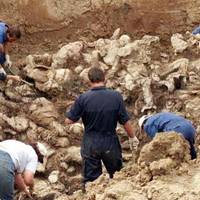
MASS GRAVE WITH 25 MURDERED CHILDREN FOUND IN AYACUCHO
Showing 1–3 of 3 items
Timeline Events 8
-
Ley de Interpretación Auténtica y Eventos de Violencia Política en Perú
In 1996, the Peruvian legislature was reshuffled in favor of the ruling party, which led to the approval of Law No. 26657, known as the Authentic Interpretation Law, which paved the way for the reelection of President Alberto Fujimori. That same year, the Ad Hoc Commission was created to review …
-
Destitución de Pilar Anchita y Elección de Donatilda Gamarra como Presidenta de FEPOMUVES
At an Extraordinary Assembly of FEPOMUVES, Pilar Anchita was removed from her position as president after refusing to sign a document dissociating herself from the PCP-SL. Donatilda Gamarra was elected as the new president. This event occurred in a context of political tension and violence, with the PCP-SL in retreat …
-
Murder of Andres Sosa by MRTA
An MRTA commando killed Andres Sosa, former leader of Patria Libre, as he was about to get into a public vehicle in Villa El Salvador. The attack was perpetrated by members of the Tupac Amaru Revolutionary Movement as part of their violent actions during that period. Sosa was a former …
2 media -
Enfrentamiento en el Puerto de Mantaro
In 1991, a confrontation took place at Mantaro Port between the Peruvian Army and the Shining Path insurgent group. During this confrontation, members of the army were attacked and killed by the Shining Path, who waited on the hill to ambush the military forces. This event is part of a …
-
MRTA coexistence with drug trafficking in San Martin
Between 1990 and 1992, the MRTA lost support from the local population due to the abuse of the quotas they used to extort money from the few remaining businessmen in the region and, in general, to the criminal practices that many of their hastily recruited militia members had engaged in. …
3 docs -
Murders in San Mateo community
On December 13, 1989, PCP-SL militants entered the community of San Mateo in the district of Churcampa. The subversives murdered three people: Paulina Gamboa Arrieta, Teodoro Gamboa Ore and Moises Arroyo Barrientos. The murders were carried out in front of the assembled population, as part of the PCP-SL's terror strategy …
2 media 8 docs -
Massacre of 37 villagers of Canayre, Llochegua
In February 1989, a group of more than 300 members of the Communist Party of Peru - Shining Path (PCP-SL) arrived in the village of Canayre, Llochegua, in boats from the Ene River. The Shining Path members killed 37 villagers, including the vigilante ronderos, and then demanded a list of …
-
Incursión Senderista en Allarpo
In 1989, in the community of Allarpo, a group of 50 hikers conducted a raid. During this raid, they accused the husband of a declarant of not complying with the tasks given to him by the group. He was brutally beaten and tortured, and finally killed by the Shining Path …
Documents 50
Yuyarisun: We Are Remembering
Yuyarisun is an archive of testimonies from community members of Ayacucho and Huancavelica, Peru, that document the political violence of Peru's last two decades. The archive is organized into four …
Until We Find Them! Progress and Challenges in the Search for the Disappeared. Comparative Experiences - Chile, Peru, El Salvador, and Sri Lanka
This publication is the second in a series whose other components are the Rapporteurship Reports 'Forced Disappearance—State Commitments' (January 2017) and 'Forensic, Humanitarian, and Judicial Challenges in the Recovery and …
An Analytical Summary of the Book Political Violence in Peru 1980–2000. Shining Path Against the State and Society. An Essay in the Political Anthropology of Violence
Essay summarizing the contributions of the book "La violencia política en el Perú 1980-2000. Sendero Luminoso contra el Estado y la sociedad" [Political Violence in Peru 1980-2000. Sendero Luminoso against …
Legal Report on the Manta and Vilca Case
Report on the configuration of a necessary theoretical framework to assess the criminal responsibility of members of the Ejército peruano for acts of sexual violence attributed to them by women …
SHINING PATH VIOLENCE AMONG THE ASHANINKA OF THE CENTRAL JUNGLE
Interim findings of a political anthropology study on the internal war in Peru (1980–2000). Introduction. I. Some general hypotheses about violence in Peru. II. The Peruvian civil war in the …
The Peruvian Justice System, Ten Years After the Final Report of the Truth and Reconciliation Commission
The period of political violence and the fight against terrorism left very deep wounds in Peruvian society. The violence affected everyone, including the actors of the justice system, who were …
Four Testimonies Ten Years After the Final Report of the Truth and Reconciliation Commission
A decade after the publication of the Final Report of the Comisión de la Verdad y Reconciliación on the internal armed conflict from 1980 to 2000, Amnesty International acknowledges and …
Chronicles of the Andean Migrant: Music, Migration, and Political Violence in Peru
This article describes the social and musical experience of migrants from the Ayacucho town of Hualla during their displacement and integration into Lima. The first phase of migration to the …
Cultural Heritage and Memory: Ten Years Later, a New Look at the Testimonies of the Truth and Reconciliation Commission
Ten years after the presentation of the Truth Commission's Report, I believe this is the moment to propose a different look at the testimonies — a perspective from which it …
Poetry and Internal War in Peru, 1980-1992: a study of poets and civil war in Peru. Summary and prologue in English.
This book undertakes the analysis of a selection of poems by six Peruvian authors written in Peru between 1980 and 1992. My reading centers on the premise that there is …
Victimology of the Peruvian Andes from the Phenomenon of Political Violence in Peru
CHAPTER I METHODOLOGICAL FRAMEWORK CHAPTER II THEORETICAL FRAMEWORK CHAPTER III HYPOTHESES, VARIABLES AND INDICATORS AND THEIR OPERATIONALIZATION CHAPTER IV DEVELOPMENT OF THE RESEARCH HYPOTHESES, VARIABLES AND INDICATORS CHAPTER V TESTING …
The Graphic Traces of Memory
Comics as a mediator of stories. It is undoubtedly disturbing to speak of genocides and massacres while maintaining the historian's distance. We invite the reader to do so, blow by …
The 'Terruco' Is the Other
Boys and girls fill the playground when they return from school. They know very little about the hardships of the past experienced in their neighborhood during the time of Sendero. …
Memory and Political Violence
With the public emergence of the Movimiento por Amnistía y Derechos Fundamentales (Movadef), the country saw memory related to the years of political violence "bloom." All manner of figures and …
Visual Memory in Peru: Photographs from the Uchuraccay Case
On January 26, 1983, eight journalists, a guide, and a community member were murdered in the town of Uchuraccay, located in the highlands of Peru, while investigating the killings carried …
The Word of the Dead or Ayacucho at the Ninth Hour
"La palabra de los muertos o Ayacucho hora nona" is one of the most significant poetry collections of what has come to be called the period of violence for some, …
From Victims to Citizens. Memories of Political Violence in Communities of the Pampas River Basin
"From Victims to Citizens. Memories of political violence in communities of the Pampas river basin" is proof that memory must no longer be understood only as the recollection of pain …
Red Cross: There Are 16,000 People Disappeared Due to Terrorism in Peru
The number of those disappeared due to the terrorism that ravaged Peru between 1980 and 2000 is close to 16,000 — double the figure calculated by the Comisión de la …
The Insurrectional Experience of the Túpac Amaru Revolutionary Movement
A version of the insurrectional experience of the Movimiento Revolucionario Túpac Amaru (MRTA) not as an added part of the violence deployed by SL, the Army, and the civilian population, …
PERU: STATUS OF ANTHROPOLOGICAL-FORENSIC INVESTIGATIONS
A document on the current state of anthropological-forensic investigations in Peru, with a brief introduction to forensic issues for members of the public interested in human rights topics, and a …
Museographic Script. Place of Memory
The mission of the Lugar de la Memoria is to serve as the reference site for all citizens regarding the period of violence that we experienced between 1980 and 2000. …
To Our Community, One Morning They Entered... Stories of Political Violence in Communities of Peru
The stories presented below speak to the power of memory and the importance that community memory holds for a transitional justice process. They challenge us to understand that transitional justice …
Political Violence in the Peruvian Labor World
The political violence that the country endured during the 1980s and 1990s struck the Peruvian labor world deeply. However, before the outbreak of the internal conflict, violence was a constant …
Fourth Report: Impact and Sustainability of Collective Reparations (2007–2011)
The Collective Reparations Program (PRC) has been implemented since June 2007 as part of the Comprehensive Reparations Plan (PIR), contained within the Recommendations of the Comisión de la Verdad y …
They Demand Justice and the Promised Reparation
Families of victims of political violence demand justice and promised reparation. The families of victims of political violence in Ayacucho went to the area where the common graves were found …
Victims Do Not Accept the Amount of Reparation
They assert that ten thousand soles cannot be the worth of a human life. We have the same rights as those who received 30,000, 35,000, and even 20 million soles …
The Response of Women from Ayacucho to the Problems of Political Violence
This thesis is a qualitative study that aims to address the response mechanisms developed by women in the Ayacucho region in response to the various problems generated by political violence, …
El Santa: The Disappeared Were Tied Up and Then Murdered by the Colina Group
After 19 years and three months, family members identify victims of political violence. According to the findings of the forensic team, the nine disappeared were bound and shot dead by …
All the Bloods. Peruvian Post-War Narrative
Political violence is one of the central concerns of twenty-first-century Peruvian narrative. The novelistic fiction approaches individual and community identity representations through memories. The first accounts of the war come …
Ayacucho, Corner of the Dead
The last twenty years of the twentieth century constituted one of the most tragic episodes in Peru's history. The armed struggle unleashed by the Partido Comunista del Perú-Sendero Luminoso and …
ÑAKARI – Cultural Forms of Suffering After Political Violence in Peru
This article describes the various cultural forms of experiencing suffering following political violence in Peru. Since it is usually assumed that we all feel pain in the same way, no …
Third Monitoring Report on Collective Reparations
Reparations Monitoring System. Situation of women who have received collective reparations. Once again, the Asociación Pro Derechos Humanos – APRODEH, in alliance with the International Center for Transitional Justice – …
Victims' Pilgrimage for Reparations Continues
Organizations of relatives and those affected by political violence in Ayacucho, the southern Andean region that was the epicenter of the fight against the insurgency between 1980 and 2000 in …
The Dark Omens: The Political Life of Shining Path in Prison (1980-1992)
This thesis focuses on the Peruvian prison system, especially the maximum-security prison Miguel Castro Castro and various Lima jails, such as Lurigancho and Santa Mónica, where the cell blocks dominated …
National Monitoring Report of the Collective Reparations Program – Phase II
This report focuses on examining the progress of the second phase of the PRC, given that it is the component of the Comprehensive Reparations Plan that reports the most progress …
Analysis of the Psychosocial Effects of Political Violence in Three Districts of the Department of Huancavelica with Different Levels of Impact
This descriptive, non-experimental study seeks to describe the psychosocial effects of political violence in three districts of the department of Huancavelica with differing levels of impact. To this end, 149 …
Ombudsman's Report No. 5: Ten Years Promoting the Right to Identity of the Population Affected by Political Violence
Since the beginning of its operations, the Defensoría del Pueblo has included among its priority issues the protection and promotion of the right to identity, given that lack of documentation …
Fleeing Violence and Building. Women and Displacement Due to Political Violence in Peru
This article describes the path to consciousness of which Peruvian women were protagonists during the era of political violence. Spontaneous organizations, formed in the context of forced migration caused by …
Against the Dream of the Righteous. Peruvian Literature Facing Political Violence
The book reviewed below brings together a set of eight essays on literary works in which the representation of political violence has been central. Added to these is a final …
The Closer, the Further Away
Victims in the photographs of violence from the Comisión de la Verdad y Reconciliación del Perú. This work is part of the project for my Master's thesis in Communication and …
Fleeing Violence and Building. Women and Displacement Due to Political Violence in Peru
This article is an outline of the path toward the consciousness of Peruvian women during the era of political violence. Spontaneous organizations formed in the context of forced migration were …
The Fujimori Syndrome
The historical background and synopsis of the Fujimori mega-trial are described, and in accordance with psychodynamics, the convergence of narcissistic perversion and paranoid imbalance in the commission of the crimes …
National Monitoring Report of the Collective Reparations Program
This document is the result of the Pilot Project Reparations Monitoring System, which the Asociación Pro Derechos Humanos - APRODEH is implementing in partnership with the International Center for Transitional …
Images of Political Violence and Libraries in Peru
Presents graphic material that forms part of the research archive underlying the book Censura: violencia política y bibliotecas en el Perú. The images are situated in the period of political …
Departmental Report of the Collective Reparations Program (PRC) Junín - Central Jungle Zone
In the case of the department of Junín, the Monitoring System found it appropriate to differentiate between the highland and jungle geographic zones, due to the particular characteristics of each. …
First Departmental Report of the Collective Reparations Program (PRC) Apurímac
This document constitutes Departmental Report 1 of the Reparations Monitoring System, a project being carried out by the Asociación Pro Derechos Humanos – APRODEH, in partnership with the International Center …
First Departmental Report of the Collective Reparations Program (PRC) Ayacucho. Report 1
This document constitutes Departmental Report 1 of the Reparations Monitoring System, a project being carried out by the Asociación Pro Derechos Humanos – APRODEH, in partnership with the International Center …