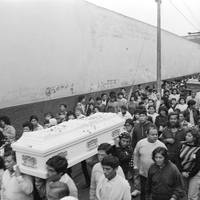
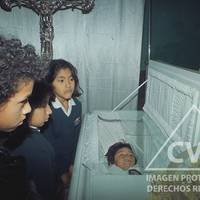
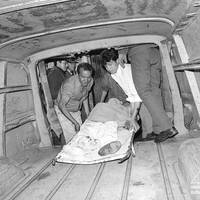
Lima accounts for only 2% of the disappeared at the national level. But this does not prevent the identification of a pattern of disappearances. Three moments are identified in the …
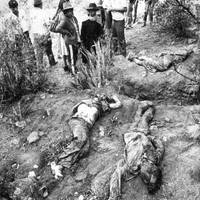
Books & Articles
33 documents in Truth and Reconciliation Commission - Peru
The capture of Guzmán, Montesinos's reaction, and lessons for the present. "Do not let time erase memories," requests retired PNP General Antonio Ketín Vidal Herrera (68). The successes of 1992, …
A few months after the capture of Abimael Guzmán, the Fujimori government dismantled the GEIN. The officers of that time accused the regime of wanting to overshadow the team's work. …
More than two thousand photographs taken by members of the Servicio de Inteligencia Nacional before, during, and after Operativo Chavín appear in the case file of the trial being conducted …
This study aims to establish, through a biopolitical lens, that Peru, during the government of Alberto Fujimori, was under a permanent state of exception; in which army barracks were used …
The trial of Alberto Fujimori Fujimori for the commission of serious crimes against human rights is, without doubt, the most important in our history, not only because a former president …
The longstanding relationship between President Alan García and Vladimiro Montesinos dates back to the period when the first Aprista government buried the investigations into the Cayara massacre, in which dozens …
The political and legal systems of Latin America have a history full of amnesties, owing both to the proliferation of armed conflicts and civil wars, and to a recurring practice …
The SIN was not always Montesinos. He transformed it in his own image and likeness after a trajectory in which institution and person were initially at opposite poles, each watching …
University thesis to obtain the degree of Bachelor in Anthropology. Advisor: Carlos Iván Degregori. The thesis contributes to the discussion of memories during the political period of Fujimorismo. To this …
The State Department report on Human Rights in Peru once again stirred the fury of the regime, to the point that President Fujimori said it had been drafted by "the …
The National Security Archive of the United States government has just declassified files on Vladimiro Montesinos, described as "Fujimori's Rasputin" (using the designation assigned to him by CARETAS as early …
Alberto Fujimori and Vladimiro Montesinos were not just joined at the hip. They also coexisted at the SIN, in a servinakuy that today shocks public opinion.
The multimillion-dollar bank accounts of Vladimiro Lenin Montesinos Torres kept growing last week, as deposits denounced by parliamentarian (PAP) Jorge del Castillo and by Alberto Fujimori himself were added to …
Nine years after the abominable massacre at Barrios Altos, perpetrated in November 1991 by Grupo Colina, Pablo Livia, the first prosecutor in charge of the case, recounts how his judicial …
The double game with surreptitious video recordings ultimately revealed that Vladimiro Montesinos was not as clever as he seemed. His recordings are absurd, because they also incriminate him, and it …
More details about the episode and medical reports confirm that journalist Fabián Salazar was tortured. In the operating room, a "debridement" was performed — that is, the irregular edges of …
Journalist and public relations professional Fabián Salazar Oliveros obtained videos and electronic files documenting the involvement of the SIN and Vladimiro Montesinos in the electoral process. But shortly after receiving …
When it was thought that Sendero Luminoso had almost disappeared with the capture of "Feliciano," the organization carried out, surprisingly, its most important military action in recent years — an …
On March 16, 1998, two television programs broadcast interviews conducted in the city of Miami with Ms. Luisa Margarita Zanatta Muedas. In those interviews, Ms. Zanatta stated that she had …
Ms. Leonor La Rosa was tortured by agents of the Army Intelligence Service, she claims, when they were trying to get her to confess who had leaked secret plans to …
The Movimiento Revolucionario Tupac Amaru (MRTA) commando that stormed the residence of the Japanese ambassador on December 17, 1996, took completely by surprise not only the hundreds of guests celebrating …
The order was to prepare "as if for a July 28 parade" — combat uniforms, oiled weapons, and live ammunition. About 20 loudspeakers were rented. After the incidents, the police …
There is no case in Peru's contemporary history like that of Vladimiro Montesinos. The accusation made by Vaticano, corroborated by other witnesses in recent days, confirms the suspicions many have …
Judge Antonia Saquicuray waited in vain from last Monday onward for the military personnel and SIN officials she had summoned to give testimony about the Barrios Altos crime, which occurred …
According to the pro-government newspaper Expreso, the attack on congressman Víctor Joy Way was planned and directed by "the general." Others believe, however, that the perpetrator was a major. And …
This cable contains information provided by a source that has been [CENSORED], according to which the investigation into the 1991 Barrios Altos killings and other information point to the same …
General Rodolfo Robles and 6 family members entered the embassy early on May 5 for a farewell meeting convened before Robles was to assume his post at the Inter-American Defense …
The U.S. Embassy in Lima requests instructions from its superiors in Washington on what to tell an Army officer who claims to have belonged to the Army Intelligence/National Intelligence Service …
Showing 1–33 of 33 documents
Timeline Events 24
-
Vladimiro Montesinos' flight to Panama
Former advisor Vladimiro Montesinos Torres escapes from the country to Panama. On October 22 he left the country at 6:39 p.m. accompanied by three people aboard a ship. The reason for leaving Panama may have been the delay of the Panamanian government in granting him asylum in the face of …
3 media 9 docs -
Fujimori announces new elections and deactivation of SIN
President Alberto Fujimori Fujimori, at around 9:00 p.m. on September 16, announced his decision to call new elections, in which he would not participate, and the immediate deactivation of the SIN. This announcement follows the Kouri-Montesinos video scandal and marks the beginning of the end of the Fujimori regime.
2 media 12 docs -
Dissemination of the Kouri-Montesinos video
The FIM presents a video where Alberto Kouri Buchamar can be seen receiving 15 thousand dollars from Vladimiro Montesinos Torres, advisor of the SIN, as part of his transfer to the ruling party's bench of Peru 2000. Congressman Kouri admits the facts but explains that the money received is not …
9 docs -
Disclosure of the Octavio Plan for surveillance of journalists
On April 30, 1999, Baruch Ivcher revealed in a telephone communication with CCN the existence of the Octavio Plan, documented by La República on May 10, 1999. Conceived in June 1996, the plan contemplated the surveillance and persecution of 20 journalists and media businessmen including Ivcher, Hildebrandt, Miró Quesada Cisneros …
1 media 2 docs -
Corruption and Human Rights Violations in Peru under Fujimori and Montesinos
During the late 1990s, the Peruvian government under President Alberto Fujimori and his advisor Vladimiro Montesinos engaged in significant corruption and human rights violations. Funds were diverted to the National Intelligence Service (SIN) under the guise of combating subversion, but were instead used for illegal activities such as phone tapping, …
-
Expansion of Presidential Powers and SIN in Peru
In 1998, the Peruvian government, under President Fujimori, expanded the powers of the National Intelligence Service (SIN) and the military to combat crime, using the public's fear of common crimes to justify this expansion. This move included the implementation of harsh legal measures, such as the concept of 'aggravated terrorism,' …
-
Mesmer Carles denounces Colina Group and murder of Pedro Huilca
Former National Intelligence Service (SIN) agent Mesmer Carles Talledo made serious allegations in the media regarding the Colina Group and the Intelligence Service. Carles Talledo blamed the Colina Group for the murder of union leader Pedro Huilca. Fernando Olivera proposed an investigative commission but the majority disqualified the testimony and …
6 docs -
Research publication on Plan Narval 96
On December 9, 1996, La República published an investigation by Edmundo Cruz that revealed the existence of Plan Narval 96, an operation carried out by the SIE under the guidance of the SIN to attack Global Televisión in Puno. The investigation also mentioned the existence of Plan Bermuda, an operation …
1 docs -
Kidnapping of General Rodolfo Robles
On November 26, 1996, retired General Rodolfo Robles was kidnapped and tried by the Supreme Council of Military Justice. Days before he had recognized Luis Sauñi as a member of the Colina Group on the program La Clave and made strong accusations against the secret operations of the SIN. His …
1 docs -
Promulgation of the Amnesty Law for General Rodolfo Robles Espinoza
In November 1996, President Alberto Fujimori of Peru promulgated a Law of Amnesty to release General Rodolfo Robles Espinoza. Robles Espinoza had been detained and processed by military justice following serious accusations he made against the National Intelligence Service (SIN) after an attack in Puno. The arrest and subsequent events …
-
Dynamite attack against Global Televisión in Puno
On October 17, 1996, there was a dynamite attack against the Global Televisión (channel 13) branch in Puno. According to a report by Mónica Vecco in La Clave, César Hildebrandt's program, the attack was perpetrated by SIN non-commissioned officers who confessed before a judge in Puno. One of the attackers, …
-
Motion to investigate military situation of La Cantuta convicts
Congressmen from different parties proposed to Congress to appoint an investigative commission on the military situation and the relationship with the Armed Forces and the National Intelligence Service of those who were sentenced for the murder of a teacher and nine students of La Cantuta, as well as those who …
-
La Cantuta Massacre and Subsequent Investigations
The La Cantuta massacre involved the murder of nine students and a professor from the Universidad La Cantuta, with their bodies discovered on 12 July 1993 in Cieneguilla, Lima. Investigations led by journalists like Ricardo Uceda faced significant challenges, including threats and lack of cooperation from authorities. The event highlighted …
-
Establishment of Intelligence Operations in the Huallaga Region
In 1993, under the Plan of Operations 'Tentáculo', eight intelligence posts were established in the Huallaga region of Peru to monitor narcotics trafficking. These posts were managed by the Army Intelligence Service (SIE) and included locations such as Tarapoto, Juanjuí-Yurimaguas, and Tocache-Juanjuí. The National Intelligence Service (SIN) played a significant …
-
Illegal Detention of Samuel Dyer Ampudia
On the night of July 27, 1992, businessman Samuel Dyer Ampudia was illegally detained at Jorge Chávez Airport by Major PNP Migdonio Torres Aliaga by order of Colonel PNP Víctor Arcila Dupp. He was handed over to PNP Colonel Carlos Domínguez Solís of the SIN, who transferred him to the …
-
Disappearance of La Cantuta students and teacher
There was a military raid on the student residence of the Enrique Guzmán y Valle University that ended with the kidnapping and disappearance of nine students and a professor. This operation was carried out by a group of SIE agents not stationed in the area and directed from the SIN, …
1 media 9 docs -
Fujimori's Coup and the Control of Narcotrafficking by the SIN
In 1991, while President Alberto Fujimori was negotiating with the United States for military aid to combat drug trafficking, his intelligence chief, Vladimiro Montesinos, and military leader, Hermoza Ríos, were monopolizing state presence in the Huallaga region, leading to widespread corruption within the Peruvian military. This situation culminated in Fujimori's …
-
Congress repeals legislative decrees
In the few days remaining until the closing of the ordinary legislature on December 15, Congress repealed 6 decrees, including 746, the National Intelligence System Law, because it left the Intelligence Service outside any democratic control. In response, the President observed these repeals and did not promulgate them. Then on …
1 docs -
Infiltration and Control of Peruvian Police Units by Vladimiro Montesinos
In May 1991, Vladimiro Montesinos orchestrated the infiltration and control of Peruvian police units by assigning two generals to the same unit. This move was seen as a strategy to ensure greater control over the police operations and to prepare the incoming director for leadership. The incident highlighted the influence …
-
Infiltration of SIN Analysts into GEIN and DIRCOTE
On February 5, 1991, Benedicto Jiménez was appointed as the liaison officer between DIRCOTE and SIN by President Alberto Fujimori. This appointment marked the beginning of increased collaboration between intelligence services and DIRCOTE, with SIN analysts entering to assist in analyzing seized documentation. However, it was later revealed that some …
-
Formation of a Special Operations Group to Combat Sendero Luminoso
In January 1991, a special operations group was formed as part of a strategy to combat the insurgent group Sendero Luminoso in Peru. The group, supported by the National Intelligence Service (SIN), was tasked with locating and eliminating the leadership of Sendero Luminoso. Tensions arose between the police and military …
-
Appointment of commission of inquiry into paramilitary groups
On September 4, 1990, the Senate of the Republic of Peru appointed an investigative commission in response to the denunciations presented by Congressman Fernando Olivera Vega two days earlier. Olivera Vega had presented recordings and transcriptions of conversations between politicians that had been intercepted by elements of the National Intelligence …
1 docs -
Telephone tapping reported
Congressman Fernando Olivera Vega presented before Congress recordings and transcriptions of conversations held between politicians that had been intercepted by elements of the National Intelligence Service (SIN). These interceptions constituted a kind of telephone espionage of political figures in the country. As a consequence of this denunciation, on September 4, …
-
Execution of a 14-year-old in Justicia, Paz y Vida
In early 1989, a 14-year-old boy, who was a delegate of sector 5 in the settlement of Justicia, Paz y Vida, was executed. He was allegedly linked to subversive activities and was kidnapped by three masked individuals. Witnesses reported that the execution was carried out by members of the SIN.