The impressive raid against Movadef, which took place last week, might suggest, judging by the resources mobilized, that the Peruvian government responded on all fronts to a major, clear, and …
Books & Articles
37 documents in Truth and Reconciliation Commission - Peru
Peru is the new cradle of drug trafficking; this is reflected in the latest report of the Organización de Estados Americanos (OEA), which was produced by the governments of the …
A look at Ayacucho — and even more so, an assessment of its situation — almost always centers on comparing past and present in terms of violence and the possibility …
The remarkable story of the brigade that, over four years, seeded informants throughout the tight-knit inner circle of "Alipio" and "Gabriel." A red cap was the lure. The police informant …
Defiant in the face of terrorism and drug trafficking, young people in the Apurímac valley are betting on a better world. The Apurímac valley has a familiar face: that of …
The National Criminal Chamber sentenced, on June 7, 2013, the leader of Shining Path in the Alto Huallaga, 'Artemio,' to life imprisonment for the crimes of terrorism, drug trafficking, and …
Illicit drug trafficking, which involves a high demand for illicit coca leaf cultivation, plays an important role in the economic dynamics of the VRAE. In this context, Sendero Luminoso has …
In the fight against what remains of the terrorist group Sendero Luminoso in the jungle and central highlands of Peru, the armed forces stopped patrolling to avoid being easy targets, …
The objective of this research is to study the set of political strategies developed by the armed forces to confront two simultaneous processes that occurred following the transition to democracy …
Prime Minister Juan Jiménez Mayor has proposed an ill-fated "Denial Law" that would criminally penalize any Peruvian citizen who denies that the groups "Sendero Luminoso" ("SL") and "Movimiento Revolucionario Tupac …
Adelinda Sedelmayer, founder of Movadef, was detained by Dirandro in January 2011. She was the link between the imprisoned leadership and criminal remnants in the Huallaga. The coordinated connection between …
Abimael Guzmán, the historical leader of the Maoist guerrilla Sendero Luminoso, marks 20 years in prison, amid the frustrated attempts of his followers to insert themselves into Peru's political life, …
The objective of this research is to study the set of political strategies that the armed forces developed to confront two simultaneous processes that occurred following the democratic transition initiated …
This publication aims to demonstrate the alliance between the terrorist organization Sendero Luminoso and drug trafficking, and its repercussions across the hemisphere. This document is the result of an analysis …
Sendero Luminoso's transformation into a 'narco-guerrilla' forces the Government to revise its defense strategy — 'narcos' have killed 50 soldiers in one year. The great terror that Sendero Luminoso now …
Thesis submitted for the degree of bachelor in history. Index: Introduction; Chapter I. Latin America and its revolutionary struggles; Chapter II. Genesis of a guerrilla: society and politics in Peru …
The case of the Partido Comunista del Perú Sendero Luminoso in the Alto Huallaga, Peru 1980–1995. We study the administration of justice by the Partido Comunista del Perú Sendero Luminoso …
A real war has been waged in Vizcatán, the impregnable Shining Path stronghold in the Valle de los Ríos Apurímac-Ene (VRAE). The battle has two sides facing each other: the …
The map found in this book, systematically delineated by Jorge Iván Bonilla and Camilo Andrés Tamayo, presents the paths along which Latin American research on the relations between communication and …
Money laundering and the financing of terrorism are crimes that are much closer to the daily lives of all Peruvians than citizens imagine. Any criminal can accumulate significant sums of …
The year 2006 was an electoral year, and from the ballot boxes emerged new voices and new faces that need to be defined. In that sense, we will surely find …
Although coca-growing farmers deny it, the presence of drug trafficking and Senderismo behind coca leaf cultivation and the mobilization of farmers is practically irrefutable.
Fifteen years ago, the districts of Sivia and Llochegua, located in the province of Huanta, in the jungle foothills connecting the departments of Ayacucho and Cuzco, were declared a liberated …
Four hundred soldiers and intelligence agents joined the pursuit in Peru today of the column of the guerrilla group Sendero Luminoso that on Saturday killed nine soldiers in the central …
At the end of 1997, we argued that what was going to happen with Sendero Luminoso during 1998, both regarding the possibility of its final defeat and its reconstitution, depended …
The Movimiento Revolucionario Tupac Amaru (MRTA) commando that stormed the residence of the Japanese ambassador on December 17, 1996, took completely by surprise not only the hundreds of guests celebrating …
There is no case in Peru's contemporary history like that of Vladimiro Montesinos. The accusation made by Vaticano, corroborated by other witnesses in recent days, confirms the suspicions many have …
The Shining Path attack on the town of Nuevo Progreso in the Huallaga region last weekend shows that the resurgence of the terrorist threat is considerably more than "the final …
In 1983, Sendero Luminoso decided to extend its traditional sphere of influence to the eastern slopes of the Andes, with the directive to "conquer support bases." This political and military …
Since 1980, Peru has been transformed into a country whose social, political, and economic life is progressively marked by violence. The onset and subsequent development of the subversive and terrorist …
The book is divided into eleven chapters. In the first, which bears the same name as the book, an attempt is made to provide a general overview of the process …
The largest coca-growing region in the world, in the hands of Senderistas, drug traffickers, soldiers, and police. Sendero Luminoso has entered the Alto Huallaga to provide protection to coca-farming peasants …
The U.S. Embassy assesses the current situation in the south-central emergency zone of Ayacucho following a two-day visit to the area in December. The report offers an analysis of the …
The Peruvian Army, together with combined police forces, has been carrying out since yesterday morning a tight siege of a contingent of more than 80 guerrillas who held the jungle …
Showing 1–37 of 37 documents
Timeline Events 50
-
Vladimiro Montesinos denounced by 'Vatican' for charging $50,000 per month
Vaticano, who had been the most important drug trafficker in Campanilla, denounced Vladimiro Montesinos in the middle of a court hearing for having charged him 50,000 dollars a month to operate the Campanilla airstrip. In a subsequent hearing, the accuser appeared in a deplorable state with obvious mental lapses and …
2 docs -
Withdrawal of the Armed Forces from the fight against drug trafficking
By means of Decree Law No. 824, Congress ordered the definitive withdrawal of the armed forces from the fight against drug trafficking. This decision was taken after years of evidence of the harmful effects of drug trafficking among the military ranks and its corrupting sequel, which contributed to the discredit …
-
Complaint against seven PNP generals for misuse of narco-taxes
The television program La Revista Dominical made public an accusation against seven PNP generals who allegedly misused real estate seized from drug traffickers. The accusation holds the PNP Director General, Victor Alva Plasencia, responsible. The Minister of the Interior, General EP Juan Briones Davila, expresses his support for Alva Plasencia's …
-
Ten EP officers charged for supporting drug trafficker
Ten officers of the Peruvian Army, among them two generals, are denounced before the 25th Criminal Court of Lima for supporting the activities of drug trafficker Abelardo Cachique Rivera. The Supreme Council of Military Justice claims for its competence the investigation of two generals involved in the mentioned drug trafficking …
-
Drug trafficker Abelardo Cachique Rivera arrested in Colombia
Drug trafficker Abelardo Cachique Rivera is arrested in Colombia. Later, in August, the military justice system sentenced him to life imprisonment. His case would later involve accusations against ten officers of the Peruvian Army, among them two generals, for allegedly supporting his drug trafficking activities.
-
Economic crisis in the Huallaga river basin due to falling coca prices
Since April 1995, there has been a crisis of proportions in the Huallaga basin for various reasons: the overstocking of cocaine in international markets, the self-supply of coca leaf and PBC by groups in Colombian territory, and the effects of aerial interdiction. The price of a bushel of coca fell …
5 docs -
Attack on Tocache airport
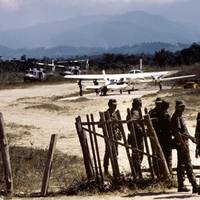
In May 1994, the Shining Path PCP attacked the Tocache airport. This attack was part of a series of violent actions carried out by the subversive organization in the Huallaga region during that period. One soldier was killed in the attack. This event occurred in a context where the PCP-SL …
-
Arrest of Demetrio Chávez Peñaherrera, drug trafficker
Demetrio Chávez Peñaherrera, alias Vaticano, one of Peru's drug trafficking bosses, is captured in Cali, Colombia. His capture represents a major blow against Peruvian drug trafficking and will later reveal corruption links with the military.
-
Capture of Demetrio Chávez Peñaherrera in Colombia
Demetrio Chávez Peñaherrera, alias Vaticano, one of the Peruvian drug trafficking bosses, is captured in Cali, Colombia. He is subsequently referred to the military justice system and sentenced to life imprisonment.
-
Denuncia de colusión entre oficiales del Ejército y el narcotráfico en Perú
In 1994, Cavalry Captain Gilmar Valdivieso Rejas, known as "Cienfuegos", denounced before the subcommittee on Drug Trafficking of the Constituent Congress the collusion of certain Army officers with drug trafficking. Among those implicated was Major Miguel Najar Acosta, who commanded the Counter-subversive Battalion No. 26 of Tocache. The accusation included …
-
Takeover of Dos de Mayo by Sendero Luminoso (Shining Path)
Between 1991 and 1992, the PCP-Sendero Luminoso consolidated its new popular committees in the Bellavista area and formed a battalion on the banks of the Abiseo River with the objective of definitively taking Dos de Mayo. In November 1993, the Shining Path managed to take the town of Dos de …
-
First Departmental Congress of CAD in Ayacucho - Expulsion of the Huayhuaco Command
From September 16 to 18, 1993, the First Departmental Congress of Anti-Subversive Self-Defense Committees was held in Ayacucho. The Congress unanimously ratified the expulsion of Javier Pompeyo Rivera T., known as Commander Huayhuaco, who had been imprisoned for drug trafficking. He was declared persona non grata to the self-defense organizations …
2 media -
Seizure of villages in the Monsoon Valley
In September 1993, more than 200 subversives of the Shining Path PCP took over several villages in the Monzon valley. During this action, the subversives located suspected informers, criminals and coca intermediaries, approximately 24 people in total. These people were killed in a bloody public act. This event was part …
-
Landing of drug traffickers' plane with military protection in Saposoa
A small plane of drug traffickers landed at the Saposoa airfield with the protection and help of an army patrol from the counter-subversive base stationed there. For providing security, each soldier of the troop received 30 dollars, the non-commissioned officer 'Pocho' received 2,000 dollars, and the technician 'Charlie' received a …
-
Capture and release of 'Chatín' after payment of US$180 thousand
Chatin', an important logistical commander of the PCP-SL's T-4 in Tocache, was captured by an army patrol under the command of 'Cienfuegos' with 200 kilos of drugs in his possession. He was taken to the Bambamarca Base but later released thanks to the intermediation of the drug trafficker 'Cero Cero', …
1 docs -
Desertion of soldiers from Counter-subversive Base Nº 30 of Punta Arenas.
Fourteen men of the troop, between classes and soldiers, deserted and took their weapons with them after the closing of the Campanilla airstrip at the end of 1992. The closure seriously affected the economy of the troops, who stopped receiving the 'quotas' paid by the drug trafficking 'firms' in exchange …
-
ADC Caimito agreement with drug traffickers
In 1993, the Caimito Self-Defense Committee (CAD) reached an agreement with the drug traffickers to provide them with security in the face of increased crime and chaos on Lake Imiria. The Caimito ADC had been formed in 1991 as a sub-base of the Puerto Alegre ADC, with the objective of …
-
Diminishing influence of drug cartels in Tamaya and Imiria
Beginning in 1993, the drug cartels significantly decreased their influence in the Tamaya River and Imiria Lake areas. This decline was the result of increased repressive actions by the Navy and the anti-drug policy promoted by the Peruvian government. By this time, the military and political presence of the PCP-SL …
-
PCP-SL begins to lose strength in Alto Huallaga
Beginning in 1993, the Communist Party of Peru - Shining Path (PCP-SL) began to rapidly lose strength in the Upper Huallaga region, although it has not completely disappeared to date. The influence of the PCP-SL in Alto Huallaga had followed a temporal vector that began in the early 1980s. This …
-
PCP-SL with strong presence on the left bank of the Huallaga river
Despite the Army's operations, in 1993 the PCP-SL maintained a strong presence on the left bank of the Huallaga River in two areas called Bolsón Cuchara and Bolsón Primavera, where it forcibly imposed its organization. The Army had retaken control of Venenillo on the left bank by establishing a military …
-
Military patrol kills eight drug traffickers in Balsayacu
A military patrol under the command of Captain José Penas Sandoval, Lieutenant Werner Huamaní Tipismana and others killed eight drug traffickers to rob them of 300 kilos of drugs. This case, known as the 'Ninja Case', was later investigated and prosecuted in 1993.
-
Assault and killing of drug traffickers by Army patrol in Boca del Rio Balsayacu
An army patrol under the command of Ensign Werner Huamaní, nicknamed 'Ninja', assaulted and killed eight drug traffickers to snatch a load of 350 kilos of cocaine paste. The bodies were thrown into the river and the eight sacks of drugs were hidden among the vegetation to be sold later.
-
The Miami Herald reveals that Vladimiro Montesinos is anti-drugs chief
US newspaper The Miami Herald publishes an exposé on Vladimiro Montesinos, identifying him as Peru's anti-drug chief. The article notes that Montesinos had previously been a defender of drug traffickers, generating controversy over his appointment to an anti-drug trafficking post.
-
Installation of U.S. Southern Command personnel in Huallaga Front
U.S. Army Southern Command personnel were installed with electronic means in the Huallaga Front Command Post to intercept radio communications. This installation was part of the anti-drug forces present in the geographical area of the Huallaga Front during the height of drug trafficking in Campanilla.
-
PCP-SL withdraws to left bank of Huallaga river
In 1992, due to various counter-subversive actions by the armed forces, the PCP-SL began to retreat to the left bank of the Huallaga River, losing control of the villages on the right bank. Despite this retreat, the PCP-SL did not cease to carry out raids in all the villages, reminding …
1 docs -
End of PCP-SL control in the Alto Huallaga area
In 1992, due to various counter-subversive actions by the armed forces, the PCP-SL began to retreat to the left bank of the Huallaga River, losing control of the villages on the right bank. From 1986 to 1992, the PCP-SL had control of the area, subordinating the coca growers and drug …
-
Drug traffickers' flight in Campanilla with military protection
A light aircraft with national registration deplaned at 15:00 hours from a runway adapted by 'Limoniel' (known as 'Vaticano') in Campanilla. The loading and unloading operation lasted between 3 to 4 minutes. The head of the Military Base received 4 thousand dollars per flight, with three to four flights per …
-
U.S. Congressional hearing on aid to Peru
On the 12th a hearing was held in Congress in which the Assistant Secretary of State for International Narcotics Matters, Melvin Levitsky, spoke. His report highlighted the efforts and progress made by the government of Peru in this regard, with emphasis on the internal war situation in the country and …
-
Military intelligence report on the Mantaro Front
The military intelligence report from the Joint Command in Washington on May 24 noted that the Army commander on the Mantaro Front was determined to stop drug trafficking and reestablish government control in Satipo, where he had set up his headquarters. In the midst of great difficulties and facing serious …
-
Murder of the Mayor of Tocache, Fredy Aliaga
In 1991, the mayor of Tocache, Fredy Aliaga, was assassinated along with a coca growers' leader. This assassination occurred in the context of the advance of the Shining Path PCP in the region, where the subversive organization was forming popular committees in different towns in the provinces of Bellavista and …
-
Formation of CAD sub-base in Caimito
In 1991, after the formation of the Puerto Alegre ADC, Caimito became a sub-base of the Self-Defense Committee with the specific objective of monitoring and combating the presence of PCP-SL in Lake Imiria. Like other CAD's, Caimito's became a sort of security and order guarantor force, although its actions were …
-
Decrease in coca leaf price in Alto Huallaga
In August 1990, the price of coca leaf suffered a severe decrease in the Alto Huallaga region. This price drop was the result of the war unleashed by the Colombian government against drug trafficking. The previous context was one of chaos and violence, with clashes between local drug trafficking firms, …
2 docs -
Seven-point compromise signed between PCP-SL and drug traffickers
On April 9, 1990, a "more organic and integral" compromise was signed between the PCP-SL and the drug trafficking firms in Uchiza. This agreement established seven fundamental points: (1) price, (2) weight, (3) direct negotiation, (4) intermediaries, (5) agreements and norms, (6) delegations, and (7) sanctions. Point 4 of the …
-
Loss of support from MRTA due to abuse and extortion
Between 1990 and 1992, the MRTA significantly lost the support of the local population in San Martin due to multiple factors. The main one was the abuse of the quotas with which they extorted money from the few remaining businessmen in the region. In addition, many of their hastily recruited …
2 docs -
PCP-SL dominance in the northern zone of Tocache
The PCP-SL maintained a stranglehold on the northern zone of Tocache until the mid-1990s, with a palpable influence until 1999. This area included towns and hamlets such as Bambamarca, Nuevo Horizonte, Escote and Santa Rosa de Mishollo, which had been organized by the PCP-SL in late 1986 and early 1987. …
1 docs -
End of lightning operations
Between 1984 and 1990, the Peruvian Army carried out successive lightning operations on both banks of the Huallaga River in order to surprise drug traffickers and the Shining Path organization operating in the area. These operations led to confrontations with PCP-SL companies operating on both banks of the Huallaga River, …
-
Population reduction in Bellavista
Bellavista was a hamlet that functioned as a PCP-SL Open Popular Committee and a drug production zone on the Aguaytia River. Due to its importance and strategic location, the Army bombed Bellavista up to 3 times using helicopter gunships, followed by ground patrols that burned the houses that survived the …
-
MRTA coexistence with drug trafficking in San Martin
Between 1990 and 1992, the MRTA lost support from the local population due to the abuse of the quotas they used to extort money from the few remaining businessmen in the region and, in general, to the criminal practices that many of their hastily recruited militia members had engaged in. …
3 docs -
Meeting between PCP-SL and drug traffickers in the hamlet of Pampayacu
At the end of December 1989, drug trafficker Demetrio Peñaherrera 'Vaticano' was summoned by a PCP-SL commander known as 'Liborio' to a meeting in the hamlet of Pampayacu. This meeting was part of a series of meetings between the PCP-SL and drug trafficking firms in the Uchiza area. Vaticano had …
-
PCP-SL incursion in Caimito
PCP-SL raided the hamlet of Caimito in November 1989 and forced the population to organize into committees. Subsequently, in 1991, after the formation of the Puerto Alegre Self-Defense Committee (CAD), Caimito became a sub-base with the objective of monitoring and combating the presence of PCP-SL in Lake Imiria. The Caimito …
-
12 additional corpses found in the Huallaga River
Another 12 corpses reappeared floating in the Huallaga River. The official version was that it was a settling of scores between drug traffickers and Shining Path members, but again, there were voices that blamed the forces controlling drug trafficking and subversion as the perpetrators of the deaths. The truth and …
-
30 dead bodies found in the Huallaga river
Thirty bodies of presumed DEA informants were found floating in the waters of the Huallaga River, although others said they were of peasants presumed to be Shining Path or drug traffickers. The official version was that it was a settling of scores between drug traffickers and Shining Path members, but …
1 docs -
DEA base installation in Santa Lucia
In September 1989, a Drug Enforcement Administration (DEA) base was installed in Santa Lucia as part of anti-drug operations in the Upper Huallaga. This installation was part of a confluence of obstacles that contributed to the decline of the town of Uchiza as an open drug trafficking center and the …
1 docs -
Appointment of Gen. Alberto Arciniegas as Political and Military Chief of Huallaga.
On May 2, 1989, one month after the Uchiza disaster, President Alan Garcia appointed Gen. Alberto Arciniegas as Political and Military Chief of Huallaga. He was installed in his position in a public ceremony in Uchiza, attended by the President of the Republic, the Minister of Defense Gen. Enrique López …
2 docs -
Death of Colombian Terrorist Henry Bladimir Delgado Salazar
Henry Bladimir Delgado Salazar, a 34-year-old Colombian citizen with passport N°AC-240556, alleged drug trafficker who participated in the armed attack on Uchiza, was transferred to the Muñoz S. Clinic in Tingo María after being wounded. He was later evacuated to Lima where he died at the Stella Maria Clinic on …
-
PCP-SL attack on Uchiza police station
On March 27, 1989, the PCP-SL attacked the police station in Uchiza, province of Mariscal Caceres. This attack marked a turning point with respect to the intervention of the Police and the Armed Forces in their fight against subversion in the coca-growing zone. The event demonstrated the level of territorial …
2 docs -
PCP-SL assault on Uchiza police station
On March 27, 1989, the PCP-Sendero Luminoso carried out an attack on the Uchiza police post that resulted in the death of 10 policemen and the complete destruction of the post. The attack was supported by the people of Uchiza in combination with drug traffickers in the area. This event …
-
PCP-SL attack destroys Uchiza police post
On March 27, 1989, the PCP-SL carried out an attack on the Uchiza police post that resulted in its complete destruction. The attack was supported by the people of Uchiza in combination with drug traffickers in the area. As a result of the attack, 10 policemen were killed. This event …
-
Hikers attack to Uchiza police station
Shining Path PCP attack with the support of drug traffickers on the Uchiza police post. This was one of the largest military operations carried out by the Shining Path, even if it was in alliance with drug traffickers. The lack of government response in support of the besieged police further …
7 docs -
Uchiza Disaster - Attack on anti-narcotics police base
On March 27, 1989, the largest anti-narcotics police base in Peru, located in Uchiza, was attacked by hundreds of narcoterrorists armed with weapons of war. During the hours of resistance, the police were in permanent radio contact with Lima and the surrounding military bases, but received no help. At dawn, …
2 media 3 docs