Photos & Videos
3 media items in Truth and Reconciliation Commission - Peru
Tag
rondas campesinas
×
 1992
1992
A group of ronderos participates in the 1992 military parade
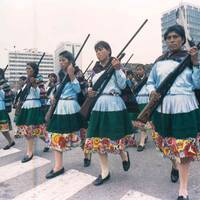 1992
1992
Women from the central highlands participate in the 1992 military parade
Showing 1–3 of 3 items
Timeline Events 18
-
Municipal Elections of November 2002
In November 2002, several historical leaders of the peasant patrols, known as rondas campesinas, successfully participated in municipal elections in Peru. Notable examples include Elmer Orihuela in Cochas, Susano Mendoza in Quinua, and Benjamín Antezana in Ocros, who assumed mayoral positions in their respective districts. This event highlights the political …
-
Attack on San Fernando de Meritori
On September 11, 1993, a group of 100 terrorists, all colonists, attempted to invade San Fernando de Meritori from three fronts: Esmeralda, Santa Rosa, and Delta. The local Rondas Campesinas and Nativas defended their community, resulting in the death of 11 terrorists. Later, the Peruvian Army intervened, detaining several individuals …
-
Transformation of Rondas Campesinas into Comités de Autodefensa
On January 15, 1993, the Peruvian government issued Supreme Decree Nº 002-93-DE/CCFFAA, mandating that Rondas Campesinas adjust their organization and functions to align with Self-Defense Committees. This transformation was part of a broader strategy to enhance local defense capabilities against subversive threats. The Self-Defense Committees were to be supported and …
-
Incident Involving Rondas Campesinas and Community Natives
In 1993, members of the Rondas Campesinas from the Native Community of Anexo San Fernando de Meritori, Satipo, were involved in an incident during an incursion into the Anexo Delta. The patrol, consisting of 30 natives, was responding to threats and the disappearance of a community member, suspecting subversive bases …
-
Formation and Actions of Rondas Campesinas in Peru
In response to insurgent activities, the Peruvian government formalized the use of armed civilian defense groups, known as rondas campesinas, through legal decrees. These groups, sometimes formed autonomously and other times under military pressure, played a significant role in counterinsurgency efforts. Notably, in Tulumayo and Andamarca, these groups expelled and …
-
Formation of the Ronda Campesina of Chongos Alto
On 15 September 1992, the Ronda Campesina of Chongos Alto was formed with Zenón Lapa Campuzano as its president. The Peruvian Army organized and trained 1586 ronderos from 17 communities in Alto Canipaco in military tactics and weapon handling to patrol and maintain order in the region. This initiative was …
-
Formation of the First Autonomous Ronda Campesina in Rodiobamba
On 17 August 1992, the first 'Ronda Campesina, Pacífica, Solidaria, Democrática y Autónoma' was organized in Rodiobamba, Cajamarca. This initiative was a response to the pressures from the PCP-SL and aimed to end the subversive violence in the region. The formation of this round marked a significant moment of citizen …
-
Violence and Community Defense in Peru
During the internal conflict in Peru, homes and schools became dangerous places due to the threat of being targeted by either the Shining Path (PCP-SL) or the military. Communities organized themselves into defense groups, such as rondas campesinas, to protect against violence. However, these groups sometimes resorted to cruel and …
-
Formation of Rondas Campesinas and CADs in Vilcashuamán
In 1991, the Rondas Campesinas were formed in Vilcashuamán by deserters of the Shining Path (Sendero Luminoso) due to personal grievances. These groups were organized with the support of the military and included the creation of Comités de Autodefensa (CADs). The CADs were established partly because of the absence of …
-
Formation of the First Central Committee of the Rondas Campesinas
On 15 July 1990, the First Central Committee of the Rondas Campesinas of Alto and Bajo Cunas was established under the leadership of Félix Damián Huaynalaya. This event marked a significant step in the local counterinsurgency efforts against the PCP-SL in the region. The committee's formation was part of a …
-
MC returns from Huancayo and supports MRTA
In 1990, in the Tsiriari valley, Mazamari district, some colonist communities had some sympathy for the MRTA, as they offered them protection from PCP-SL. In the colonist community Dos de Mayo, MC, who had previously sympathized with PCP-SL, decided to support MRTA after returning from Huancayo in 1990. Upon returning …
2 docs -
Formation and Actions of the Rondas Campesinas in Tulumayo
In early 1990, the communities in Tulumayo, Peru, organized self-defense groups known as rondas campesinas to combat the PCP-SL (Shining Path) insurgency. Initially met with skepticism by the Peruvian Army, the rondas demonstrated their resolve by ambushing and defeating a PCP-SL column in March 1990. This led to a collaboration …
-
Formation of Rondas Campesinas in Ayacucho
In 1989, under the presidency of Alan García Pérez, the Peruvian government began arming local peasant patrols known as 'rondas campesinas' in Ayacucho to combat the insurgent group PCP-SL. This movement was partly a response to increased violence from the PCP-SL and was supported by both military coercion and the …
-
Assassination of Professor Julio Sánchez and the Formation of the First Ronda Campesina
In 1988, the assassination of Professor Julio Sánchez in Shapaja by elements of the MRTA led to the creation of the first ronda campesina in the department of San Martín. This event marked a significant moment in the local community's response to political violence. The formation of these peasant patrols …
-
Recognition of Rondas Campesinas and Comités de Autodefensa in Peru
In the 1980s, two types of peasant patrols, or 'rondas campesinas', were formed in Peru. On November 6, 1986, the government of Alan García Pérez officially recognized the peaceful, democratic, and autonomous peasant patrols in the northern departments of Cajamarca and Piura. Meanwhile, in the central highlands, armed 'rondas contrasubversivas' …
-
Assassination of Flavia Gastelu
Flavia Gastelu, a leader of the Rondas Campesinas, was assassinated in 1984 in Ayacucho, Peru. She was one of the many leaders, both male and female, who were killed by the PCP-SL during a period of intense political violence. Her role as a mediator in a fragmented society highlights the …
-
Rise of the Rondas Campesinas Contrasubversivas in Ayacucho
In 1984, the rondas campesinas contrasubversivas gained prominence in Ayacucho, particularly in the communities of Chiquintirca and Anchihuay. These groups evolved from spontaneous defensive actions to organized offensive strategies against subversive elements, including the PCP-SL. By forming central committees and conducting patrols, they played a crucial role in the local …
-
Military Violence and Sexual Abuse in Peru
In 1983, marines arrived in the town of Huanta, Peru, and organized the Rondas Campesinas. During this period, there were numerous reports of military personnel committing acts of sexual violence against women, exploiting their power over the local population. These acts were part of a broader context of discrimination and …
Documents 36
The Peasant Patrols: Clarifying the Term
The rondas campesinas play a fundamental role in the exercise of Communal Justice, as recognized by Article 149 of the Political Constitution itself. However, in everyday language, other organizations are …
SHINING PATH VIOLENCE AMONG THE ASHANINKA OF THE CENTRAL JUNGLE
Interim findings of a political anthropology study on the internal war in Peru (1980–2000). Introduction. I. Some general hypotheses about violence in Peru. II. The Peruvian civil war in the …
State of the Art. The Conflict in Peru
The civil war in Peru during the 1980s and 1990s was a fertile ground for the emergence of new actors with various names, but reflecting a similar reality. The so-called …
Memory of a War. Peru 1980-2000
The central theme of this book is the intense class struggle that took place in Peru during the period 1980–2000, and the positions taken by social classes, political parties, the …
Patrolling by Our Law
The Programa de Acceso a la Justicia Rural - PROJUR has found it appropriate to reissue this book, which documents the process of managing this new Rondas Law and the …
The Peasant Self-Defense Patrol in Peru: Citizens Against the State
The author points out the fact that the State insists on its prerogative: the monopoly on the use of force (to avoid saying violence); but it forgets the reason and …
The Peasant Self-Defense Patrol in a Peasant Community in Northern Peru: La Toma in Cajamarca
This article analyzes the rondas campesinas as self-defense institutions created by highland communities in Peru. The case study focuses on the rondas of the community of La Toma, Cajamarca, in …
Legal and Political Pluralism in Peru: The Case of the Rondas Campesinas of Cajamarca
This article analyzes, from an anthropological perspective, some challenges of political and legal pluralism in the case of the Rondas Campesinas of Cajamarca (Peru). Social organizations born with the purpose …
Legal and Political Pluralism in Peru: The Case of the Rondas Campesinas of Cajamarca
The article analyzes, from an anthropological perspective, some challenges of political and legal pluralism in the case of the Rondas Campesinas of Cajamarca (Peru). Social organizations born with the purpose …
Legal and Political Pluralism in Peru: The Case of the Peasant Self-Defense Patrols of Cajamarca
The article analyzes, from an anthropological perspective, some challenges of political and legal pluralism in the case of the Rondas Campesinas of Cajamarca (Peru). Social organizations born with the aim …
The Peasant Patrols of Chota and San Marcos: Analysis of Patrol Justice Practices
The study presented here describes the role played by communal actors — such as the rondas campesinas — in local contexts and relationships, as in Chota and San Marcos, where …
Past, Present, and Future of Anti-Subversive Peasant Patrols in Junín, Peru (1990-2001)
In just over three decades, the social and political order in the Peruvian Andean region was modified time and again, seeking to build, on the ruins of the previous order, …
Compendium of Legislation for Victims of Terrorism
The compendium presents the legislation in force as of 2002 directed at three sectors affected by terrorism: a) civilian and political authorities and public officials and servants; b) members of …
Peasant Patrols and Insurgent Organizations in Peru
Narrating how the Rondas Campesinas in Peru originated, spread, and grew stronger, as well as their valuable contribution to the defeat of Sendero Luminoso, are the objectives of this work. …
THE RONDAS CAMPESINAS IN PERU. A BRIEF HISTORY
The author explains the origin and subsequent spread of the Comités de Autodefensa Civil in Peru, more generically known as rondas campesinas. Chapter I: The origins. Chapter II: The rondas …
How We Learned to Kill Our Neighbor: Memory, Violence and Reconciliation
We have always believed that to achieve true national reconciliation it was necessary to know the truth of what had occurred during the years of the war. In the following …
The Internal Pacification Process
The purpose of this study is to review what terrorism meant, how the threat it posed to society and the State was overcome, evaluate the possible re-emergence of flare-ups, and …
Decline and Survival of the Peasant Self-Defense Patrols of Northern Peru
The peasant patrols of northern Peru formed an increasingly solid movement over fifteen years. Emerging from the people to combat the problem of cattle rustling, the first patrol was organized …
Peasants in the War. Or How People Begin to Toughen Up
Studies on the decade of violence have paid little attention to the meaning and structure of the civil defense committees, better known as "montucos." In most cases, the view of …
The peasant patrols and the defeat of Shining Path.
The book constitutes, in its own way, a tribute to the Quechua peasants of Ayacucho. Men and women who were at first entirely unarmed, destined to play the role of …
The Armed Forces and April 5
This text is part of a research project on the development of civil-military relations since the restoration of democracy in 1980. The original proposal was based on the observation that …
Peasant Patrols. Power, Violence and Self-Defense in Central Cajamarca
The report analyzes the forms of peasant self-defense organized to confront cattle rustling in a recurrently violent society, settled in the central micro-region of the department of Cajamarca, in the …
Army Continues Distributing Weapons to Peasants
The Peruvian army continues to distribute weapons to peasant paramilitary organizations, despite official statements claiming that guerrillas no longer pose a threat. According to sources linked to the joint command …
The Ronderos Speak: The Search for Peace in the Andes
Working Paper No. 45. Series: IEP Workshops No. 2. Presentation. I. THE STRONGEST ORGANIZATION OF THE NATIONAL PEASANTRY: THE RONDAS CAMPESINAS OF THE NORTH. II. "NO LONGER LIKE A MEEK …
Report of the Special Rapporteur, Mr. B. W. Ndiaye, on His Mission to Peru from May 24 to June 2, 1993
The Special Rapporteur on extrajudicial, summary or arbitrary executions has expressed on numerous occasions, in his reports to the Commission on Human Rights, his concern over the persistent and serious …
Political Violence: Forms of Community Response in Ayacucho
The subject of this research is political violence, the types of community responses to it, and its effects at the productive and social reorganization level during the period 1989–1990 at …
Extrajudicial Executions in Ayacucho; Peruvian Military and Sendero Blamed in Separate Cases
The document describes two separate mass killings, one committed by guerrillas and another by the military. The report indicates that the military patrol that committed the killings was under the …
In the Eye of the Storm: An Ayacucho Trip Report, Part I
Ambassador Quainton describes in detail the situation of political violence and insurgency in Ayacucho, detailing the historical roots of the region and the current political and military situation. He notes …
Extrajudicial Executions in Ayacucho: Peruvian Military and Sendero Are Blamed
The document discusses two separate mass killings, one committed by the guerrillas and one by the military. The report indicates that the military patrol that committed the killings was under …
Montoneras, Bandits and Peasant Patrols
"Montoneras, bandoleros y rondas campesinas" is a systematic study of high analytical elaboration that, while accounting for a political-social phenomenon whose actors operate fundamentally within the jurisdiction of the department …
In the Eye of the Storm: Report of a Trip to Ayacucho, Part I
Ambassador Quainton describes the situation of political violence and insurgency in Ayacucho, detailing the region's historical roots and the current political and military situation. He notes that Ayacucho is of …
The Role of Peasant Social Organizations in the Counter-Subversive Strategy: The Expreso Proposal
In all areas and aspects of national life, various social and political actors, legitimately concerned about the situation of violence that Peru is experiencing, have developed and continue to develop …