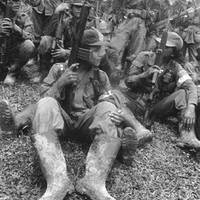
San Martín
Place
Perú

San Martín

Timeline Events 168

  1. Presence of left-wing parties in Sint Maarten's popular movements

    Between 1975 and 1977, the leftist parties began to have a presence in the popular and peasant movements of Sint Maarten. They succeeded in getting the Agrarian Leagues of San Martin, centralized in the FASMA, to move away from the influence of SINAMOS and demand greater autonomy. The struggles, which …

    San Martín, Perú Informe CVR
  2. Victims in the department of San Martín

    During the period 1980-2000, the department of San Martin registered 84 Quechua-speaking and 620 Spanish-speaking deaths and disappearances. Among the Quechua-speaking victims, the Shining Path PCP was responsible for 43 victims, State agents for 28, the MRTA for 3, and 10 undetermined cases. Among the Spanish-speaking victims, the Shining Path …

    San Martín, Perú Informe CVR, páginas 5205, 5222
  3. Regional Congress of SUTE-SM in Sauce

    In 1981, the Regional Congress of the Unitary Union of Education Workers of San Martin (SUTE-SM) was held in the town of Sauce, province of San Martin. During this congress the Board of Directors of SUTE-SM was renewed for a period of two years. This event was part of the …

    Sauce, provincia de San Martín, departamento de San Martín, Perú Informe CVR, página 311
  4. Departmental Congress of the MIR-VR in Tarapoto

    In 1981 the Departmental Congress of the MIR-VR (Movimiento de Izquierda Revolucionaria - Voz Rebelde) was held in Tarapoto where the Departmental Directorate was elected. The objective of this Departmental Directorate was to strengthen the movement through permanent coordination with all the militant cadres distributed in the different districts and …

    Tarapoto, San Martín, Perú Informe CVR, página 311
  5. Dynamiting of premises in several districts

    On August 1, 1981, multiple simultaneous bombings took place in different parts of Lima. The targets included 4 premises of Acción Popular (AP), 3 of them located in San Martin and Barrios Altos, as well as 3 Peace Courts and the ESAL Office in Villa el Salvador. These attacks were …

    Lima, Perú Informe CVR, página 414
  6. MIR-VR mapping and census mission in Sint Maarten

    Between 1982 and 1984, MIR-VR area managers had the mission to travel throughout their area in order to prepare maps for population and housing censuses. This task included locating villages, roads, paths, trails, trails, native ethnic groups, bridges, streams, among other geographic and demographic elements. The people leaving the political-military …

    San Martín, Perú Informe CVR, página 311
  7. Political-military doctrinary school of the MIR-VR in Alto Shanusi

    In January 1982, the Revolutionary Left Movement (MIR-VR) organized a political-military doctrinal school in the area of Alto Shanusi. It was attended by a total of fifteen physically and ideologically fit combatants, determined to begin the armed struggle. The purpose of the school was to train future subversives in the …

    Alto Shanusi, San Martín, Perú Informe CVR, página 311
  8. First departmental strike in Sint Maarten

    The Comando Unitario de Lucha (CUL), presided over by Professor Lucas Cachay, promoted the first departmental strike of urban and rural workers in 1984. The CUL was formed in Tarapoto to fill the leadership vacuum evidenced during the 1982 strike in Juan Guerra and Tabalosos, which left 5 dead and …

    San Martín, Perú Informe CVR
  9. Subversive MIR-VR detachment with 35 combatants in San Martin

    Between 1982 and 1984, the MIR-VR carried out territorial reconnaissance work in San Martin, with area leaders who traveled throughout the area making maps, carrying out population and housing censuses, and locating villages, roads, paths, trails, trails, native ethnic groups, bridges and streams. By 1984, the MIR-VR already had a …

    San Martín, Perú Informe CVR, página 311
  10. Murder of peasant farmers in Huayrapata and others

    On July 2, 1984, members of the PCP-Sendero Luminoso broke into the towns of Huayrapata, San Antonio de Paterini, San Martin and Quillabamba, all located in the district of San Francisco, province of La Mar. The attackers killed forty peasants who had collaborated with the forces of law and order. …

    Huayrapata, San Antonio de Paterini, San Martín y Quillabamba, distrito de San Francisco, provincia de La Mar, Ayacucho, Perú Informe CVR, página 89
  11. Drug production in Tamaya River

    Beginning in 1985, drug production and commercialization began to take place openly on the Tamaya River, along with Lake Imiría and the Abujao River in Ucayali. This area became an important center for the production of cocaine paste. Drug trafficking in this area later intensified when drug trafficking firms were …

    Río Tamaya, Ucayali, Perú Informe CVR, página 360
  12. Takeover of the Historical Museum of Huaura

    An emerretista commando took over the Historical Museum of Huaura and recovered a silver replica of San Martin's sword, the original flag with which he proclaimed the independence of Peru, the Order of the Sun Decoration and the original of San Martin's Proclamation. With this symbolic gesture, the MRTA sought …

    Huaura, Lima, Perú Informe CVR, página 610
  13. Conflict between MRTA and PCP-SL

    In 1986, tensions between the MRTA and PCP-SL escalated into confrontations, notably in the district of Tocache, San Martín. Despite efforts by MRTA to collaborate with other political groups, PCP-SL viewed them as adversaries, leading to increased hostilities in subsequent years. By September 1987, PCP-SL officially categorized MRTA as part …

    Tocache, San Martín, Peru Chunk 670.0
  14. Sint Maarten regional strike with government negotiation

    In April 1986, a regional strike was held in San Martin which forced the APRA government to send an official delegation made up of several ministers and high-ranking officials. The negotiation lasted 16 uninterrupted hours before the Comando Unitario de Lucha (CUL) and 200 delegates from the rank and file. …

    San Martín, Perú Informe CVR, p. 315
  15. Rape in Cuartel Morales

    In 1987, in the Morales barracks located in the province of Tarapoto, department of San Martin, a witness reported to the TRC the rape of a woman by numerous military personnel. This case is part of the systematic pattern of sexual violence perpetrated by members of the armed forces against …

    Cuartel Morales, Provincia de Tarapoto, Departamento de San Martín Informe CVR, página 315
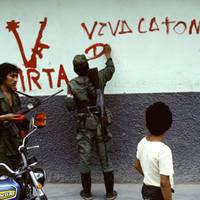
  16. MRTA's First Military Campaign 'Tupac Amaru Vive'

    In 1987, the MRTA (Túpac Amaru Revolutionary Movement) initiated its first military campaign, 'Tupac Amaru Vive,' involving incursions into various cities in San Martín, Peru. This campaign was part of a broader struggle for regional autonomy and political decentralization, amidst the backdrop of political violence. The Peruvian state responded by …

    San Martín, Peru 316
  17. Comandante Raúl leads the Northeastern Front (FNO) of MRTA

    Commander Raul was the military commander of the Northeastern Front (FNO) of the MRTA in the department of San Martin between 1987 and 1988. As military chief, together with the political chief, the press chief and the logistics chief, he was in charge of coordinating the FNO's political actions. The …

    San Martín, Perú Informe CVR, página 311
  18. Opening of MRTA guerrilla front in San Martin

    The MRTA cut the truce granted to Garcia and opened a guerrilla front in the department of San Martin with great publicity, barely three months after the attempt to nationalize the banks. The television coverage given to the MRTA campaign was enormous. The guerrilla chief Victor Polay became a well-known …

    Departamento de San Martín, Perú Informe CVR, página 69
  19. Escalation of Violence in San Martín and Ucayali

    In 1987, the violence in the northeastern region of Peru intensified with the involvement of new actors, including the Movimiento Revolucionario Tupac Amaru (MRTA) and paramilitary groups like 'Rodrigo Franco'. The MRTA initiated armed conflict in the southern part of San Martín, clashing with both state forces and the PCP-SL …

    San Martín and Ucayali, Peru página 322
  20. Arrests and disappearances by the Army in Sint Maarten

    Since the Peruvian Army took charge of the counter-subversive struggle in San Martin, it committed numerous abuses against the civilian population. Violations included arbitrary detentions, robberies, theft of objects and money from the inhabitants of the department's villages and towns. Between 1987 and 1993, 496 arbitrary detentions and 98 people …

    San Martín, Perú Informe CVR, página 337
  21. Establishment of the Sisa Valley detachment

    In 1987, the MRTA established the Valle del Sisa military detachment, commanded by Carlos Arango, as part of its organizational structure in the Northeastern Front. This area was considered strategic by the MRTA because it was an access point to the Alto Mayo, Middle Mayo, Huayabamba Valley and Central Huallaga. …

    Valle del Sisa, Provincia de El Dorado y provincia de Saposoa, San Martín, Perú Informe CVR, páginas 313-314
  22. First FEDIP-SM Founding Congress

    In May 1987, the first Founding Congress of the Frente de Defensa de los Intereses del Pueblo de San Martín (FEDIP-SM) was held, with a majority of the provincial bases in attendance. This congress formalized the creation of an organization that would become the main leadership body in the region, …

    San Martín, Perú Informe CVR, páginas 315-318
  23. Murder of the aprista provincial mayor of Picota, Rafael Saavedra Saavedra Saavedra

    On June 16, 1987, members of the PCP-Sendero Luminoso assassinated the APRA provincial mayor of Picota, Rafael Saavedra Saavedra. This assassination was part of the selective annihilation strategy of the PCP-SL against local political authorities, especially those linked to the Peruvian Aprista Party (PAP). The crime occurred in the context …

    Picota, San Martín, Perú Informe CVR, página 133
  24. MRTA military training in Pongo de Caynarachi-Shanusi

    In 1987 an army of MRTA subversives was formed in San Martin. Both forces (political and military) united in the Pongo de Caynarachi-Shanusi area, where they trained militarily and politically during the months of July, August and September 1987. The training was led by Víctor Polay Campos (c) Rolando, Néstor …

    Pongo de Caynarachi-Shanusi, San Martín, Perú Informe CVR
  25. Attack on Campanilla

    On July 13, 1987, the town of Campanilla in the San Martín and Loreto regions of Peru was taken and occupied by subversive forces. During this event, public buildings were set on fire. This incident was part of a series of violent actions in the region during the late 1980s.

    Campanilla, San Martín and Loreto, Peru 1.4.7.4. Cronología, Zona III: San Martín y Loreto
  26. Beginning of the Tupac Amaru Vive Military Campaign

    On October 8, 1987, the MRTA began the 'Tupac Amaru Vive' Military Campaign, commanded by Victor Polay Campos (c) Rolando, Nestor Cerpa (c) Evaristo and Miguel Rincon (c) Francisco. The campaign began with the raid on the villages of Tabalosos and Macedas. This date was chosen to commemorate the 20th …

    Tabalosos y Macedas, San Martín, Perú Informe CVR, páginas 320
  27. MRTA entry to Tabalosos

    On October 8, 1987, on the anniversary of Ernesto Che Guevara's death, a contingent of eighty men of the Tupac Amaru Revolutionary Movement (MRTA) entered the town of Tabalosos in the department of San Martin. This action was part of a series of town seizures that the MRTA carried out …

    Tabalosos, San Martín, Perú Informe CVR, página 136
  28. MRTA raid in Juanjui

    In November 1987, the MRTA raided Juanjui as part of the 'Tupac Amaru Vive' Military Campaign. This action forced the government to decree a state of emergency and a curfew in San Martin. The incursion unleashed a strong state repression that included the persecution of union and popular leaders, especially …

    Juanjui, San Martín, Perú Informe CVR, páginas 313-315
  29. Military control of San Martin handed over to the FFAA

    In the face of MRTA's armed actions in the northeastern jungle of the country, the government proceeds to hand over to the Armed Forces the political-military control of the entire department of San Martin. This decision comes after a column of seventy MRTA members seized several localities in the department, …

    San Martín, Perú Informe CVR, páginas 128, 136
  30. Establishment of the Political-Military Command of the Huallaga Front.

    After the MRTA raid on Juanjui on November 6, 1987, the department of San Martin was declared in a state of emergency. In November 1987, the Political-Military Command of the Huallaga Front was established as the Peruvian State's response to MRTA's armed actions in the region. This military command was …

    San Martín, Perú Informe CVR, página 324

Showing 1–50 of 168 events

Photos, Videos & Documents 27

Showing 1–27 of 27 items

Sub-entities 7