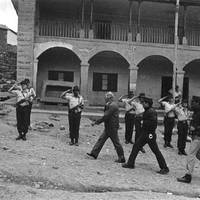
Fernando Belaúnde Terry
Person

Fernando Belaúnde Terry

Timeline Events 75

  1. Beginning of the internal armed conflict and first appearance of Sendero Luminoso (Shining Path)

    In 1980, President Fernando Belaunde Terry restored freedom of the press in his first act of government. That same year, Sendero Luminoso made its first official appearance, initiating terrorist acts. The violence broke out in a period of democracy and free press, causing initial bewilderment in the media, which had …

    Perú Informe CVR, páginas 1154-1156
  2. 1980 General Elections

    On May 18, with the participation of 6,382,002 voters, the General Elections were held. Fernando Belaunde Terry of Acción Popular won with 46% of the presidential votes, followed by Armando Villanueva del Campo of the PAP with 28% and Luis Bedoya Reyes of the PPC with 10%. The leftist blocs …

    Perú Informe CVR, página 4723
  3. Partial Transfer of Power in Peru and the 1980 Secret Defense Laws

    In June 1980, shortly before Fernando Belaúnde Terry assumed the presidency, the outgoing military government of Francisco Morales Bermúdez enacted secret laws concerning the National Defense System. These laws ensured that military institutions retained significant control over defense matters, limiting the power of the incoming civilian government. The laws were …

    Peru 251
  4. Return of Media to Private Ownership in Peru

    In November 1980, the Peruvian government, under President Fernando Belaúnde Terry, formalized the return of media outlets to private ownership. This marked a significant shift from the previous military regime's control, which had expropriated television and newspaper companies in the early 1970s. The return to democracy allowed media outlets to …

    Peru Página 491
  5. State of emergency declared in five provinces of Ayacucho

    On October 12, the government decreed a state of emergency in five of the seven provinces of Ayacucho (Huamanga, Huanta, Cangallo, La Mar and Víctor Fajardo) and suspended for sixty days the constitutional guarantees related to individual freedom and security. This was the first time a state of emergency was …

    Huamanga, Huanta, Cangallo, La Mar y Víctor Fajardo, Ayacucho, Perú Informe CVR, página 4743
  6. First state of emergency declared in Ayacucho

    President Fernando Belaunde Terry declared for the first time a state of emergency in Ayacucho commanded by the FFPP through supreme decree 036-81-IN. The state of emergency was extended for sixty days to five Ayacucho provinces: Huanta, La Mar, Huamanga, Cangallo and Victor Fajardo. General GC Carlos Barreto Bretoneche assumed …

    Ayacucho, Perú Informe CVR, páginas 360-361
  7. State of emergency declared in Ayacucho

    On October 12, 1981, one day after the assault on the El Tambo police post, the President of the Republic, architect Fernando Belaunde Terry, declared a state of emergency in five provinces of the department of Ayacucho: Cangallo, Huamanga, Huanta, La Mar and Víctor Fajardo. This situation implied the suspension …

    Provincias de Cangallo, Huamanga, Huanta, La Mar y Víctor Fajardo, Ayacucho, Perú Informe CVR, página 3263
  8. Attacks on Abimael Guzman's birthday

    The PCP-SL celebrated Abimael Guzmán Reinoso's birthday with simultaneous attacks in Lima and Ayacucho during December 1982. This wave of attacks was part of an escalation of violence that characterized the end of that year. The attacks occurred in a context of growing terrorist activity that led the Armed Forces …

    Lima y Ayacucho Informe CVR, páginas 67-68
  9. Belaunde's ultimatum to subversives

    President Fernando Belaunde Terry issued an ultimatum to the subversives to surrender their weapons before the Armed Forces took control of the emergency zone. This ultimatum took place in the context of a growing wave of terrorist attacks, especially in Ayacucho, and preceded the decision of the Armed Forces to …

    Perú Informe CVR, página 68
  10. FFAA takes control of emergency zones in Ayacucho

    On December 31, 1982, the Armed Forces assumed internal control of the department of Ayacucho in the face of a growing wave of attacks. A total of 2,000 military troops took possession of the provinces declared in a state of emergency, starting with the rural areas. This decision was precipitated …

    Ayacucho Informe CVR, páginas 68-69
  11. Human Rights Violations in Ayacucho During the Internal Conflict in Peru

    During the early 1980s, the Peruvian government, under President Fernando Belaúnde Terry, faced criticism for its handling of human rights violations amid the internal conflict with the Shining Path (PCP-SL). Despite reports from organizations like Amnesty International about extrajudicial killings by state security forces, the government largely ignored these allegations. …

    Ayacucho, Peru
  12. Appointment of the Commission of Inquiry into the Uchuraccay Events

    President Fernando Belaunde Terry appointed the Investigation Commission of the Uchuraccay Events on February 2, 1983, chaired by writer Mario Vargas Llosa. This commission was created to investigate the murder of eight journalists on January 26, 1983 in the community of Uchuraccay. The commission presented its report a month later, …

    Lima, Perú Informe CVR
  13. Assembly of the Vargas Llosa Investigation Commission in Uchuraccay

    The Investigation Commission of the Uchuraccay Events, presided over by writer Mario Vargas Llosa and appointed by President Fernando Belaunde Terry on February 2, 1983, held a community assembly in Uchuraccay. This commission was created to investigate the murder of eight journalists on January 26, 1983. During the assembly, the …

    Uchuraccay, Huanta, Ayacucho, Perú Informe CVR
  14. PAP Fraternity Rally

    On February 18, 1983, the Peruvian Aprista Party (PAP) held its traditional Fraternity Rally. This annual political event was a characteristic activity of the Aprista party during the period of Fernando Belaunde Terry's government. The rally took place in a political context marked by the subversive violence of the PCP-Sendero …

    Perú Informe CVR, página 72
  15. Delivery of the Report of the Investigating Commission of the Uchuraccay Events to President Belaunde

    The Investigation Commission of the Uchuraccay Events delivered its report to President Fernando Belaunde Terry in a special ceremony held in the Government Palace at the beginning of March 1983. The Commission had been constituted on February 2, 1983 by Supreme Resolution Nº 0016-83-PCM, with the task of preparing a …

    Palacio de Gobierno, Lima, Perú Informe CVR
  16. Presentation of the Report of the Investigation Commission of the Uchuraccay Events (Vargas Llosa Commission)

    The Investigation Commission of the Uchuraccay Events, appointed by President Fernando Belaunde Terry on February 2, 1983 and presided over by writer Mario Vargas Llosa, presented its report one month after its creation. The commission was created to investigate the murder of eight journalists on January 26, 1983 in the …

    Lima, Perú Informe CVR (página no especificada en el fragmento)
  17. Resignation of the Minister of the Interior Fernando Rincón

    In April 1983, Fernando Rincón resigned as Minister of the Interior. This resignation took place in a context of intense criticism of his administration, particularly due to the Uchuraccay massacre that took place in January of that year and the systematic human rights violations denounced during his term. Despite criticism …

    Perú Informe CVR, página 73
  18. Meeting of the National Defense Council

    On May 9, 1983, the National Defense Council met, presided over by the President of the Republic Fernando Belaunde Terry. In this meeting, the evolution of the counter-subversive struggle in the country was discussed. This meeting took place in a context of intensified political violence, particularly in the department of …

    Perú Informe CVR, página 74
  19. First National Agrarian Unitary Congress

    On May 11, 1983, the First National Agrarian Unitary Congress began, an event of great importance for the peasant sector of the country. During this congress, the participants severely criticized the agrarian policy of Fernando Belaunde Terry's government. This event took place in a context of growing protests and social …

    Perú Informe CVR, página 74
  20. Suspension of individual guarantees in all of Peru

    On May 30, 1983, the Peruvian government decreed a state of emergency throughout the country for sixty days, suspending several individual guarantees. This measure was taken in view of repeated acts of sabotage at different points of the interconnected electrical system. Days before, on May 27, there had been a …

    Perú Informe CVR, página 74
  21. State of emergency throughout the country

    On May 30, 1983, the Peruvian government decreed a state of emergency throughout the country for sixty days. This measure was taken in view of repeated acts of sabotage at different points of the interconnected electrical system and the growing wave of terrorist violence. Several of the individual guarantees were …

    Perú Informe CVR, página 74
  22. Appointment of General Juan Balaguer as Senior Director of the Civil Guard

    General GC Juan Balaguer was appointed Superior Director of the Civil Guard on June 3, 1983. This appointment signified his return to that position after two years of absence. The appointment took place in a context of intense anti-subversive activity and reorganization of the police forces in the country. Balaguer's …

    Perú Informe CVR, página 76
  23. Belaunde Terry's visit to Ayacucho

    On June 12, 1983, President Fernando Belaunde Terry visited Ayacucho in a context of intense anti-subversive military activity. Previously, on June 11, General EP Clemente Noel Moral had declared in El Observador that "Ayacucho is living a war situation and the detainees are considered prisoners of war". During his visit …

    Ayacucho Informe CVR, páginas 75-76
  24. Resignation of Minister of Labor Alfonso Grados Bertorini

    On June 27, 1983, the resignation of the Minister of Labor, Alfonso Grados Bertorini, during the government of Fernando Belaunde Terry, was confirmed. Later, in August of the same year, it was announced that Patricio Ricketts Rey de Castro was leaving the Ministry of Labor to move to the Ministry …

    Perú Informe CVR, página 76
  25. Belaunde's message to Congress

    On July 28, 1983, President Fernando Belaunde Terry presented his annual message to the Congress of the Republic. In this speech, Belaunde Terry demanded the reestablishment of the death penalty, in the context of the escalation of political violence that the country was going through. This message was given in …

    Lima Informe CVR, página 76
  26. Letter from Amnesty International to Fernando Belaúnde Terry

    Amnesty International (AI) sent letters to President Fernando Belaúnde Terry pointing out that human rights violations and excesses were being committed in the anti-subversive struggle. The president rejected the letters on August 18, 1983, calling the institution 'communist' and declaring that the letters would go 'directly to the trash can'. …

    Perú Informe CVR, páginas 77, 79
  27. Ministerial changes

    On August 15, 1983, changes were announced in the ministerial cabinet of Fernando Belaunde Terry's government. Patricio Ricketts Rey de Castro left the Ministry of Labor to become Minister of Education. Joaquín Leguía assumed the Labor portfolio replacing Ricketts. These changes took place in a context of confrontations between the …

    Perú Informe CVR, página 77
  28. Belaunde's rejection to Amnesty International's letters

    President Fernando Belaunde Terry publicly rejected the letters sent by Amnesty International (AI) that pointed out that in the anti-subversive struggle, excesses and human rights violations were being committed. Belaunde Terry not only described this institution as 'communist', but also declared that these letters would go 'directly to the trash …

    Perú Informe CVR, página 77
  29. Interpellation to the Minister of Fisheries Fortunato Quesada Lagarrigue

    The Minister of Fisheries, Fortunato Quesada Lagarrigue, appeared in the Chamber of Deputies to answer the interpellation presented by the aprista parliamentary cell. This interpellation took place in the context of the approaching municipal elections and was part of the parliamentary activities of supervision of Fernando Belaunde Terry's government. The …

    Lima Informe CVR, página 79
  30. Swearing-in of three new ministers

    On December 30, 1983, three new ministers were sworn in to the cabinet of President Fernando Belaunde Terry. José Benavides Muñoz assumed the portfolio of Energy and Mines. FAP Lieutenant General Jose Zlatar Stambuck assumed the portfolio of Aeronautics. Ismael Benavides Ferreiros assumed the Fisheries portfolio. This ministerial change took …

    Perú Informe CVR, página 81
  31. National strike organized by Asamblea Nacional Popular

    On March 22, 1984, a national strike called by the National Popular Assembly was held, which was described as successful. This mobilization took place in a context of growing social and political conflict in the country, with multiple protests from different sectors. The strike generated violent repression by the forces …

    Perú Informe CVR, página 85
  32. Strike of transporters

    During April 1984, a transportation workers' strike in Peru lasted 48 hours. This strike took place in a context of multiple social mobilizations that characterized that period, including strikes by the medical union and municipal workers. The transport workers' strike was part of a wave of labor protests that affected …

    Perú Informe CVR, página 86
  33. Motion of censure against Minister of the Interior Luis Pércovich Roca

    A motion of censure was presented in the Chamber of Deputies against the Minister of the Interior, Luis Pércovich Roca, due to the violent repression of the national strike that had taken place previously. This motion was presented in the context of growing criticism of the government's handling of the …

    Lima Informe CVR, página 86
  34. Sandro Mariátegui takes over Foreign Affairs

    Senator Sandro Mariátegui Chiappe assumed the portfolio of Foreign Affairs on April 9, 1984, replacing the outgoing minister. This ministerial change took place in the context of Fernando Belaunde Terry's government, during a period of intense political and social crisis in the country. Mariátegui Chiappe would later also serve as …

    Perú Informe CVR, página 86
  35. Murder of coca growers' leader and provincial mayor Tito Jaime

    On April 17, 1984, Tito Jaime, who was a coca growers' leader and provincial mayor of Leoncio Prado in the department of Huanuco, was assassinated. The event occurred in a context of intense political violence in the country, during the first government of Fernando Belaunde Terry. This assassination took place …

    Leoncio Prado, Huánuco Informe CVR, página 86

Showing 1–50 of 75 events

Photos, Videos & Documents 10

Showing 1–10 of 10 items