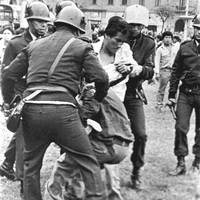
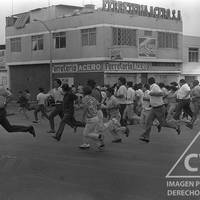
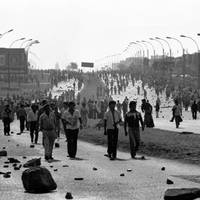
Throughout its existence the CGTP has suffered the persecution, exile, and assassination of many of its activists and leaders. Many are the martyrs who have fallen in the trade union …
Books & Articles
5 documents in Truth and Reconciliation Commission - Peru
Since the historic July 18, 1977, there had not been such a broad mobilization — one that managed to overcome divisions and differences — under very different conditions from that …
Juan José Gorriti, a telephone workers' union leader, took over as General Secretary of the CGTP three years ago. Since then, he has organized eight departmental mobilizations, and this week …
Relatives of Pedro Huillca recognize the faces of members of the Colina group at the crime scene. More than four years after his murder was committed, the case is far …
Showing 1–5 of 5 documents
Timeline Events 25
-
Mobilization Against Economic Policy and Privatization of Petroperú
On January 23, 1997, the CGTP organized a significant popular mobilization demanding the government to amend its economic policies. The movement had notable impacts in Huaraz, Chimbote, and Talara, where a general strike was called by the municipality to protest the privatization of Petroperú. The tension surrounding the privatization was …
-
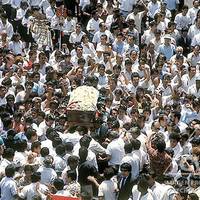
Assassination of CGTP General Secretary Pedro Huilca
Pedro Huilca, General Secretary of the CGTP (General Confederation of Peruvian Workers), was assassinated on December 18, 1992. This crime occurred in a context of extreme violence in Lima, where the subversive groups Sendero Luminoso and MRTA had intensified their terrorist actions. Huilca's murder was part of a series of …
2 media 2 docs -
Murder of Pedro Huilca Tecse
Pedro Huilca Tecse, General Secretary of the CGTP (General Confederation of Peruvian Workers), was assassinated on December 18, 1992 in Lima. It was initially assumed that the PCP-SL (Communist Party of Peru - Shining Path) was responsible. This assassination was part of a series of attacks against union leaders during …
2 media 2 docs -
Assassination of Pedro Huilca, General Secretary of CGTP
Murder of Pedro Huilca, secretary general of the CGTP. The case is attributed to the Colina Group but the perpetrator has not yet been clearly identified.
2 media 3 docs -
Assassination of Pedro Huilca Tecse
Pedro Huilca Tecse, the Secretary General of the Confederación General de Trabajadores del Perú (CGTP), was assassinated on December 18, 1992. Prior to his assassination, he had attended the Annual Conference of Executives (CADE) and called for a national agreement addressing labor issues. His assassination followed a period of tension …
-
Murder of Juan Andahua Vergara
Juan Andahua Vergara was Secretary of Organization of the CGTP, Secretary General of the National Federation of Workers of Beverages and Soft Drinks and Secretary of Organization of the Coca Cola Workers Union. He was assassinated on August 3, 1992 in Lima. According to the report, he was allegedly murdered …
-
Alberto Fujimori's coup d'état
On April 5, 1992, Alberto Fujimori executed a coup d'état. On April 6, union leaders of SUTEP and CGTP rejected and condemned the coup. The union premises remained surrounded by military and police. Days later, a leader denounced the disappearance of Olmedo Auris, who was forcibly removed from the union …
-
Pedro Huilca Tecse's Leadership in Peruvian Labor Movement
Pedro Huilca Tecse was a prominent labor leader in Peru, known for his roles in various labor organizations. In March 1992, he was elected Secretary General of the Confederación General de Trabajadores del Perú (CGTP) during its tenth National Congress. His approach to maintaining open dialogue with business and government …
-
General strike CGTP
The General Confederation of Peruvian Workers (CGTP) called a general strike during August 1990, in the context of the recently initiated government of Alberto Fujimori. The strike had little acceptance among the population and did not succeed in paralyzing the country's activities. This strike took place at a time of …
-
Prosecution of 300 physicians
On December 7, 1989, the Peruvian government ordered the prosecution of 300 doctors for their compliance with the strike maintained by their union. This was one of a series of violations of freedom of association documented by the CGTP during that year. The government measure took place in a context …
-
Kidnapping of Saturdino Calapuja Salazar
Saturdino Calapuja Salazar, a member of the CGTP (General Confederation of Peruvian Workers), was kidnapped in December 1989 in Lima. After participating in a CGTP meeting, he was kidnapped and ill-treated. He was later found in an agonizing state in downtown Lima. This case is part of a series of …
-
General strike called by CGTP
The General Confederation of Peruvian Workers (CGTP) called and carried out a general strike on December 1, 1988. This strike took place in the context of an economic and political crisis during the government of Alan García Pérez. The strike was part of the multiple protests and union mobilizations that …
-
National strike of October 1988
On October 13, 1988, a national strike was called in the context of a serious economic crisis affecting the country. This strike was one of several carried out during 1988, a year in which the monetary devaluation accelerated, generating higher inflation and a fall in workers' real income. In September …
-
Police Raid on the Federation of Luz y Fuerza
During a national strike in October 1988, the police raided the headquarters of the Federation of Luz y Fuerza in Peru. They arrested three union leaders and a worker, accusing them of terrorism. The police claimed to have found flyers from the PCP-SL, dynamite cartridges, tires, and explosives at the …
-
Armed strike called by PCP-SL
The PCP-Sendero Luminoso called for an armed strike that lasted from July 18 to 22, 1988. This armed strike was carried out parallel to the national strike called by the CGTP (General Confederation of Peruvian Workers) scheduled for July 19 and 20. The armed strike was part of the actions …
-
Confrontation between PCP-SL militants and CGTP and IU demonstrators at Plaza 2 de Mayo
During the meeting of the national strike called jointly by the CGTP (left) and the CTP (aprista) on January 28, 1988, a violent confrontation took place between militants of the PCP-Sendero Luminoso and demonstrators of the CGTP and Izquierda Unida in Lima's Plaza 2 de Mayo. This national strike had …
1 media -
Attempted attack in Dos de Mayo square
During the national strike called by the CGTP on January 28, 1988, hooded members of the PCP-Sendero Luminoso infiltrated the march that was taking place in the Dos de Mayo square. Their objective was to try to dynamite the CGTP premises and assassinate the leader of the Communist Party of …
1 media 1 docs -
National strike called by CGTP and CTP
The CGTP (left) and the CTP (aprista) held a joint meeting and called a national strike for January 28, 1988. The strike was not fully observed in Lima. During the national strike rally in Plaza 2 de Mayo, a confrontation took place between PCP-SL militants and CGTP and IU demonstrators. …
1 media -
Confrontation in Plaza Dos de Mayo
During a national strike called by the CGTP, a group of approximately 40 hikers violently confronted demonstrators in the middle of Plaza Dos de Mayo. The objective of the attack was to attack Jorge del Prado, senator and leader of the United Left. This confrontation occurred in the context of …
1 media -
National Strikes in Peru and the Role of PCP-SL
On January 28, 1988, a national strike was held in Peru, organized by the CGTP and the Asamblea Nacional Popular (ANP), which distanced itself from the ideology of the PCP-SL. Additional strikes occurred on July 19-20 and October 13 of the same year, maintaining a clear separation from PCP-SL's influence. …
-
National strike called by CGTP
On May 19, 1987, a national strike was called by the General Confederation of Peruvian Workers (CGTP). According to the CVR report, this measure of force was moderately successful. The strike took place in the context of political and social tensions of the Alan Garcia Perez administration, in a year …
-
National strike called by CGTP
On May 19, 1987, the first national strike of this period took place, called by the CGTP (General Confederation of Peruvian Workers), marking the end of the social truce that had characterized the first years of the APRA government. The outstanding feature of this strike was that it coincided with …
-
National strike called by CGTP and Comando Nacional Unitario de Lucha (National Unitary Command of Struggle)
On November 29, 1984, a national strike was called by the General Confederation of Peruvian Workers (CGTP) and the National Unitary Command of Struggle (Comando Nacional Unitario de Lucha). This strike took place in a context of intense political violence and escalation of the internal armed conflict in the country. …
1 docs -
General Strike in Peru
On January 15, 1981, a general strike was called by the CGTP, CTP, and CNT in Peru. The strike was nearly total, with significant participation from the mining and metallurgical sectors, as well as many agro-industrial complexes. The strike highlighted the unity and strength of the labor movement in Peru …
-
48-hour national strike called by CGTP
On February 27 and 28, a 48-hour national strike was called by the CGTP. The government's attitude towards the strike generated two tendencies: a hard line headed by the Minister of the Interior General EP Luis Cisneros Vizquerra, willing to punish the strikers; and a more flexible one headed by …
1 docs