Organization

Congreso de la República

Timeline Events 22

  1. March of settlers to Congress

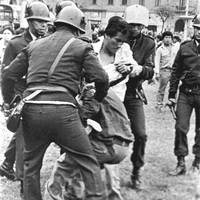
    In October 1980, ten thousand residents of 10 young towns of San Juan de Lurigancho marched to the Congress of the Republic, demanding a solution to the water and sewage problem. The demonstrators succeeded in getting the senators to request an "Emergency Plan" for Canto Grande. However, since the promised …

    San Juan de Lurigancho, Lima, Perú Informe CVR, página 431
  2. Deportation and assassination of congressman Reynaldo Rivera Romero linked to drug trafficking

    In 1983, Reynaldo Rivera Romero, the deputy for Tingo Maria of the Popular Action party, was disqualified from the Congress of the Republic after his links to drug trafficking were proven. In April 1984, coca growers' leader Tito Jaime Fernandez, who was mayor of Leoncio Prado province for the second …

    Tingo María, Huánuco, Perú Informe CVR, página 2528
  3. Appointment of the Uchuraccay Events Investigation Commission (Vargas Llosa Commission).

    On February 2, 1983, the Peruvian government appointed the Uchuraccay Events Investigation Commission, chaired by writer Mario Vargas Llosa. This commission was created to investigate the massacre of eight journalists that occurred on January 26, 1983 in the community of Uchuraccay, province of Huanta, Ayacucho. According to the CVR report, …

    Perú Informe CVR (páginas mencionadas: 162, 175)
  4. Belaunde's message to Congress

    On July 28, 1983, President Fernando Belaunde Terry presented his annual message to the Congress of the Republic. In this speech, Belaunde Terry demanded the reestablishment of the death penalty, in the context of the escalation of political violence that the country was going through. This message was given in …

    Lima Informe CVR, página 76
  5. Presentation of report on Uchuraccay in Congress

    On September 20, 1983, a report on human rights violations in Ayacucho was presented to the Congress of the Republic. During the session, politicians from different political parties stood up to give their opinion on the report presented. Representatives of the United Left (IU) and the Peruvian Aprista Party (PAP) …

    Lima Informe CVR, página 79
  6. Premier Sandro Mariátegui Chiappe appears before Congress

    Premier Sandro Mariátegui Chiappe appeared before the Congress of the Republic to present his government plan. This presentation was made in the context of the political and social crisis that the country was going through during the government of Fernando Belaunde Terry. Mariátegui Chiappe had assumed the Foreign Affairs portfolio …

    Lima Informe CVR, página 87
  7. Approval of police reorganization law

    The Peruvian Congress passed a law declaring the reorganization of the Peruvian Police Forces. This measure was part of the institutional reforms implemented during the transition government, in a context of intense political violence and questions about the performance of law enforcement. The police reorganization sought to restructure the country's …

    Perú Informe CVR, página 107
  8. Five corpses found in Accomarca cemetery

    On September 13, 1985, the bodies of five people were found in the cemetery of Accomarca, whose bodies, still bleeding, showed traces of having been very recently shot, shortly before the arrival of an investigative commission of the Congress of the Republic, which included Congressman Fernando Olivera of the Popular …

    Cementerio de Accomarca, provincia de Vilcashuamán, departamento de Ayacucho, Perú Informe CVR, página 3402
  9. Massacre of peasants in Cayara

    A massacre of peasants was committed by the Peruvian Army in Cayara. Not only was a machinery of silence and impunity set up, but also unjustifiable political maneuvers in the Congress of the Republic effectively prevented the official acceptance of the serious facts. The investigation had to be paralyzed due …

    Cayara, Ayacucho, Perú Informe CVR, página 21
  10. 200 disappearances reported in Huancavelica

    Senator Raúl Ferrero Costa, president of the Justice and Human Rights Commission, publicly revealed that during the first five months of Alberto Fujimori's government, around 200 people had disappeared in the department of Huancavelica. This denunciation took place in a context of growing concern about the government's respect for human …

    Huancavelica, Perú Informe CVR, página 192
  11. Request for extraordinary powers to Congress

    The ministerial cabinet appeared before the Congress of the Republic to request that extraordinary powers be granted to the Executive Branch. These powers were to legislate in four specific areas: national pacification, reorganization of the State, private investment and promotion of employment. This request was framed in a context of …

    Perú Informe CVR, página 195
  12. Censure of Minister of Agriculture Enrique Rossl Link

    The Chamber of Deputies of the Congress of the Republic censures the Minister of Agriculture, Enrique Rossl Link. This occurred in the context of growing tensions between the Executive Power and the Congress during the government of Alberto Fujimori. The censure took place at the end of the first ordinary …

    Lima, Perú Informe CVR, página 206
  13. Fujimori's self-coup and dissolution of Congress

    On April 5, 1992, President Alberto Fujimori, with the support of the Armed Forces and the police, dissolved the Congress of the Republic, intervened in the Judicial Power and installed an unconstitutional regime known as the 'Government of Emergency and National Reconstruction'. When the military coup perpetrators closed the Congress, …

    Lima, Perú Informe CVR, página 3704
  14. Swearing-in of Máximo San Román as constitutional president

    On April 21, 1992, Máximo San Román Cáceres was sworn in as constitutional president before members of the dissolved Congress of the Republic at the Lima Bar Association headquarters. The ceremony was attended by 44 of the sixty senators and 149 of the 180 deputies. This act took place after …

    Colegio de Abogados de Lima, Lima, Perú Informe CVR, página 212
  15. Collapse of the Fujimori regime

    The collapse of the Fujimori regime was triggered by the exposure of its corrupt character. This led to the formation of a transitional government headed by the recently appointed president of the Congress of the Republic, Dr. Valentín Paniagua, who faced the most urgent challenges of the beginning of the …

    Lima, Perú Informe CVR, página 22

Showing 1–22 of 22 events

Photos, Videos & Documents 17

Showing 1–17 of 17 items